Google Ads vs. Local SEO: Which Should Your Business Invest In First?
A decision-making guide for local business owners weighing Google Ads vs. Local SEO, covering cost models, timelines, budget allocation by business stage, and how to run both channels together for maximum ROI.
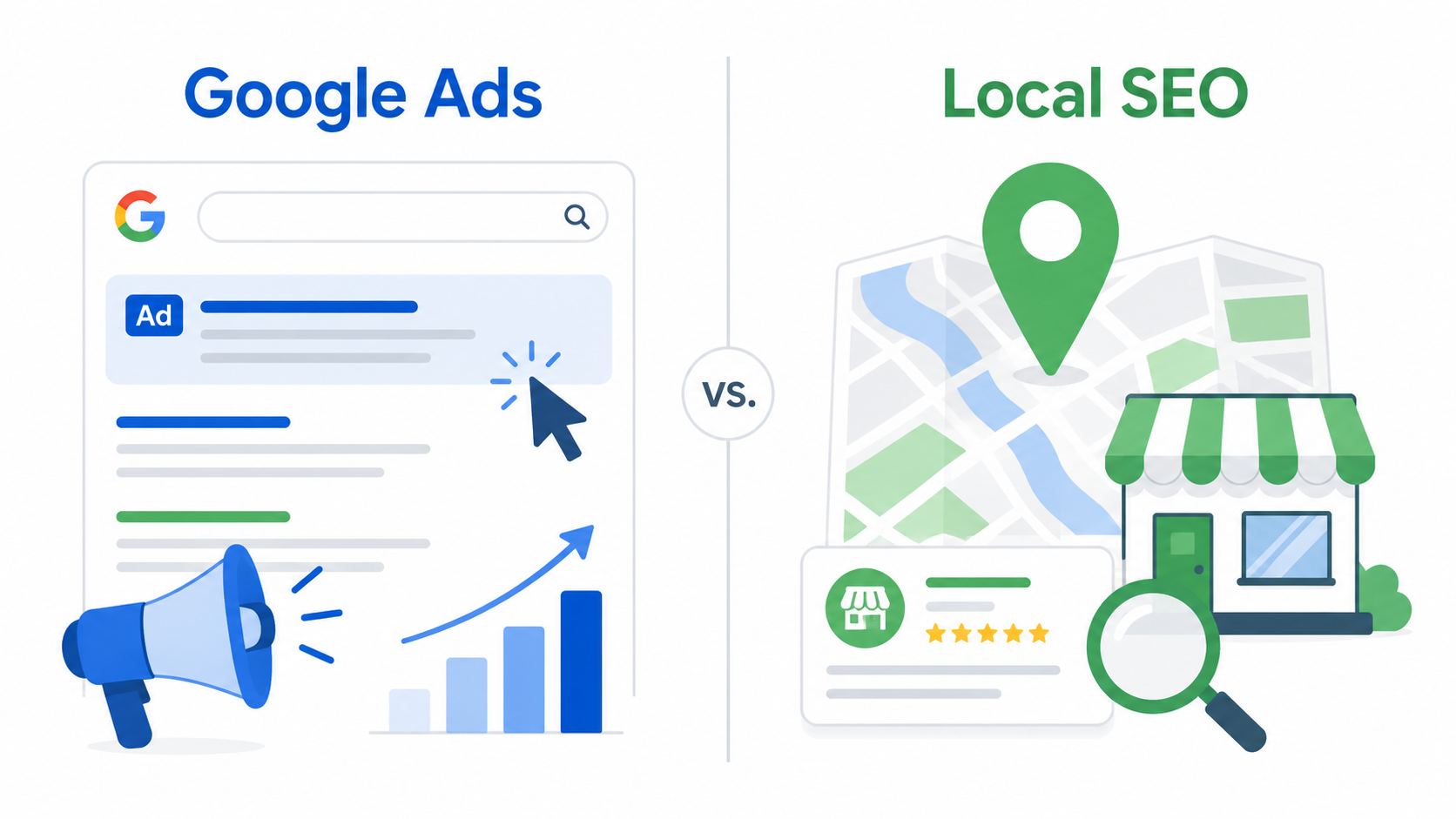

If you are a local business owner deciding where to put your marketing budget, the question of Google Ads vs. Local SEO is one of the most important you will face. The short answer: most local businesses should start with Local SEO, then layer in Google Ads once organic visibility is established. Local SEO builds a compounding asset that keeps driving traffic without ongoing ad spend. Google Ads delivers faster results, but costs money every day your campaign runs. The right choice depends on your timeline, budget, and how competitive your local market is. This guide breaks down both channels so you can make a clear, confident decision about where your next marketing dollar should go.
What Is Local SEO and How Does It Work?
Local SEO is the process of optimizing your online presence so your business appears in location-based search results, specifically in Google's local pack and on Google Maps. It includes optimizing your Google Business Profile, earning citations from local directories, building location-specific content on your website, and accumulating positive reviews. Unlike national SEO, Local SEO targets people in your city or service area who are actively searching for what you offer right now.
The Google Business Profile Is the Core of Local SEO
Your Google Business Profile (GBP) is the single most important asset in a local SEO strategy. When someone searches for a plumber, HVAC company, or restaurant near them, the businesses that appear in the top three spots of the local pack are almost always those with fully optimized, well-reviewed GBP listings. Incomplete profiles, outdated hours, or missing service categories are among the fastest ways to lose local visibility to a competitor.
Local SEO Builds Long-Term Search Authority
Every optimized citation, earned review, and locally relevant blog post adds to a foundation that grows over time. A business that invests in Local SEO consistently for 12 months will compound that effort into rankings that continue delivering traffic even after direct work on the channel slows down. This is fundamentally different from paid advertising, where traffic stops the moment your budget does.
What Is Google Ads and How Does It Work for Local Businesses?
Google Ads is a paid advertising platform that lets your business appear at the top of search results immediately, for any keyword you choose to bid on. You pay each time someone clicks your ad. For local businesses, the most common format is search ads, which show when someone in your target area types a relevant query, such as "roof repair Phoenix" or "emergency plumber near me." Google Ads also includes local service ads (LSAs), display ads, and retargeting campaigns.
Google Ads Delivers Immediate Visibility
If you are launching a business, running a seasonal promotion, or trying to fill your calendar fast, Google Ads can put you in front of buyers within hours of setting up a campaign. There is no waiting period for authority to build. For a new business without any organic rankings, paid ads are often the only way to appear on page one initially.
Cost Per Click in Local Markets Can Be High
Depending on your industry and location, local keywords can carry a cost per click of anywhere from $2 to $25 or more. Competitive service categories like legal, HVAC, roofing, and dental regularly exceed $10 to $15 per click. At those rates, a modest $1,000 monthly budget generates between 40 and 100 clicks, and not every click converts. Understanding your conversion rate and customer lifetime value is essential before committing to a paid budget.
Google Ads vs. Local SEO: The Core Differences
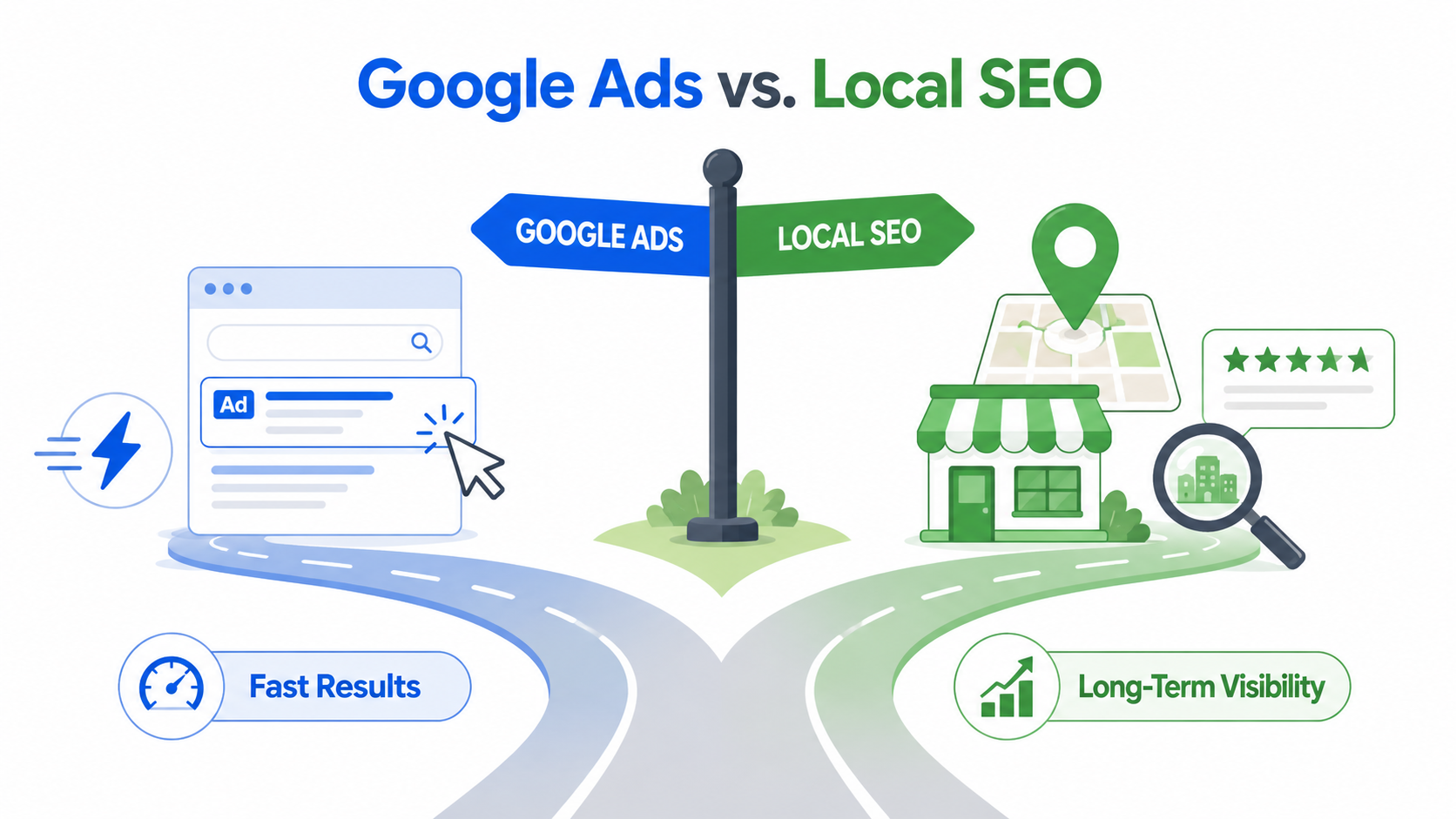
The two channels are built on different mechanics, timelines, and cost structures. Neither is universally better. Understanding where each one excels is the starting point for making a smart investment decision.
When You Should Start with Local SEO First
For most established or newly launched local service businesses, starting with Local SEO and Google Business Profile optimization is the higher-leverage investment. Here is why.
You Plan to Be in Business Long-Term
Local SEO is an investment in permanent digital infrastructure. A business that ranks in the top three of the local pack for high-intent searches generates consistent, free traffic every single month. If you intend to build a sustainable business and not just run a short campaign, the ROI of Local SEO compounds dramatically over 18 to 36 months in ways that paid advertising cannot match.
Your Budget Is Limited
If you are working with a lean budget, as outlined in our guide on how much a local business should spend on marketing, your highest-ROI channel is almost always Local SEO. A few hundred dollars per month dedicated to citation building, review generation, and GBP optimization can generate a return that would cost three to five times as much through paid search.
Your Competitors Are Not Dominating Local Search Yet
If you operate in a market where local competitors have weak or inconsistent Google Business Profiles, outdated citation data, and few reviews, you have a real opportunity to take the top spots with consistent effort over six to twelve months. First-mover advantage in local SEO is real: the businesses that establish authority early are significantly harder to displace later.
When You Should Start with Google Ads First
There are specific situations where investing in Google Ads before or alongside SEO is the smarter move. Here is what those scenarios look like.
You Need Revenue Right Now
A new business needs customers before it can afford to wait six months for organic traffic. If your pipeline is empty and you need booked jobs or appointments within the next 30 days, Google Ads is the only channel that can deliver that speed. The cost is real, but so is the alternative of having no business.
You Are Running a Time-Limited Promotion or Event
Seasonal businesses, limited-time offers, or event-based promotions benefit directly from paid ads. A landscaping company promoting spring clean-up packages or an HVAC company pushing pre-summer AC tune-ups can target the exact search terms buyers are using during a narrow time window, something that organic SEO simply cannot be optimized fast enough to capture.
You Operate in a Highly Competitive Local Market
In dense metro markets where competitors have invested years into Local SEO, it can take 12 to 18 months to crack the top three organic results. While you are building that authority, paid ads keep you visible for the terms that drive the most revenue. This is not an argument against investing in SEO. It is an argument for running both simultaneously once budget allows.
How Google Ads and Local SEO Work Better Together
The businesses that win in local search over the long run are almost never running just one channel. They use paid ads to capture immediate demand and Local SEO to reduce their cost of customer acquisition over time. When both are running in parallel, paid ads generate revenue while organic rankings build, eventually allowing a business to reduce ad spend without losing visibility.
Paid Ads Provide Data That Improves SEO
Running Google Ads first gives you real conversion data: which keywords actually generate calls, which ad copy earns clicks, and which offers resonate with your market. That data is enormously useful for shaping your Local SEO content strategy. Instead of guessing which keywords to target organically, you have proof of what converts.
Local SEO Reduces Paid Ad Dependency Over Time
As your organic rankings improve, you can allocate your paid budget toward higher-funnel keywords or seasonal campaigns instead of covering the basics. This is the natural progression of a healthy digital marketing stack: a strong website from our web design and development team, combined with consistent SEO, reduces your cost per acquisition every month.
How to Allocate Your Budget Between Google Ads and Local SEO
Budget allocation depends on your business stage, market competition, and how urgently you need new customers. The following breakdown works well for most local service businesses.
Early-Stage Business (0 to 12 Months)
- 60% to 70% of marketing budget toward Google Ads to generate immediate leads
- 30% to 40% toward Local SEO setup: GBP optimization, citation building, and review strategy
- Focus paid ads on your 3 to 5 highest-converting service keywords only
- Do not spread ad budget across too many keywords at this stage
Growing Business (12 to 36 Months)
- 50% toward Local SEO as organic rankings begin to contribute traffic
- 50% toward Google Ads to maintain visibility and capture demand not yet covered organically
- Begin testing social media marketing to build brand awareness and retargeting audiences
- Review cost per lead from each channel quarterly and shift budget toward lower-cost sources
Established Business (36+ Months)
- Lean into whichever channel is producing the lowest cost per lead
- Use paid ads strategically for new service launches, seasonal pushes, or competitor conquest campaigns
- Invest in content, video production, and brand-building to defend organic rankings
Choosing the Right Digital Marketing Partner for Both Channels
Managing Google Ads and Local SEO at the same time requires different skill sets. Paid search management requires ongoing bid optimization, ad copy testing, and conversion tracking. Local SEO requires technical expertise, content strategy, and consistent citation and review management. Our case studies show how a combined approach helped a landscaping company add $4.5 million in revenue and helped a Phoenix retailer more than double its average order value. The results are achievable, but they require a team that knows how to run both channels without sacrificing one for the other.
What to Look for in an Agency
Look for an agency that can show you documented results from both paid and organic campaigns for businesses in your industry. Ask specifically about their Local SEO process: how they optimize Google Business Profiles, how they build citations, and how they approach review generation. For paid ads, ask how they structure campaigns for local businesses and what their typical cost per lead looks like across different industries.
Questions to Ask Before You Sign
Before committing to any marketing partner, ask how they report results, what metrics they use to evaluate success, and how they handle underperforming campaigns. A transparent agency will walk you through their process, show you reporting dashboards, and be honest about realistic timelines for both paid and organic results.
Frequently Asked Questions
How long does Local SEO take to show results?
Most local businesses begin seeing measurable movement in Local SEO rankings within 3 to 6 months of consistent effort. Highly competitive markets or businesses starting from zero online presence may take 9 to 12 months to crack the top three positions in the local pack. The compounding nature of Local SEO means results continue to grow after that point without proportional increases in spend.
Is Google Ads worth it for small local businesses?
Google Ads can be highly effective for small local businesses when campaigns are structured correctly and budgets are focused on a small number of high-converting keywords. The risk for small businesses is spreading budget too thin across too many keywords. A well-managed paid advertising campaign with a $500 to $1,500 monthly budget can generate a consistent flow of leads when the targeting, landing page, and call-to-action are dialed in.
Can I do Local SEO myself without hiring an agency?
You can handle some elements of Local SEO yourself, particularly claiming and filling out your Google Business Profile, asking customers for reviews, and ensuring your NAP (name, address, phone) data is consistent across major directories. However, technical SEO, content strategy, and ongoing citation management are time-intensive and require expertise to execute well. Most business owners find the opportunity cost of doing it themselves outweighs the cost of professional management.
What is a good cost per lead from Google Ads for a local business?
A reasonable target cost per lead from Google Ads varies significantly by industry. Home services like HVAC and plumbing typically see cost per lead ranges of $30 to $100. Legal and medical categories often run higher, from $80 to $200 or more. The most useful benchmark is your customer lifetime value: if a typical job is worth $500, a $75 cost per lead with a 30% close rate is entirely sustainable.
Should I pause Google Ads once my Local SEO is working?
Pausing Google Ads entirely once Local SEO gains traction is a common mistake. Organic rankings are never fully guaranteed, and algorithm updates can reduce visibility without warning. A smarter approach is to reduce paid ad spend gradually as organic traffic increases, reallocating that budget toward competitive keywords your SEO has not yet captured or toward seasonal campaigns.
Does having a Google Ads campaign help my SEO rankings?
Running Google Ads does not directly improve your organic search rankings. Google has confirmed that ad spend has no influence on organic ranking algorithms. However, paid ads can indirectly support SEO by driving traffic to your site, which can signal engagement if visitors stay on the page. The more meaningful connection is that Ads provide conversion data you can use to build better SEO content.
What industries benefit most from Local SEO?
Local SEO delivers the strongest ROI for service-area businesses with repeat customer potential: HVAC, plumbing, roofing, landscaping, dental, legal, automotive, and home improvement. Businesses in these categories benefit because their customers search locally with high intent and are often ready to book within hours of conducting a search. If your business depends on local foot traffic or local service calls, Local SEO management is one of the highest-leverage investments available to you.
The Bottom Line: Which Channel Should You Start With?
For the majority of local businesses, the answer is Local SEO first, Google Ads second. Local SEO builds the compounding foundation that reduces your cost of customer acquisition over time. Google Ads fills the gap while that foundation is being built and stays useful for competitive keywords, seasonal pushes, and fast-moving opportunities. Choosing one and ignoring the other is a false economy. The businesses that consistently win local market share run both, with a budget allocation that shifts toward organic over time.
If you are ready to build a strategy that combines both channels without wasting budget, the team at Weslo Digital can help. We have built Local SEO and paid advertising programs for local service businesses across Phoenix and beyond, and our work speaks in results, not promises. Get in touch to start a conversation about what the right mix looks like for your business, or explore our paid advertising services to see how we manage campaigns built for local growth.