Local SEO for Contractors: How to Get More Calls from Google Maps
A step-by-step guide to local SEO for contractors covering Google Business Profile optimization, review generation, citation building, location pages, and Google Local Services Ads, written for home service businesses that want more inbound calls from Google Maps.
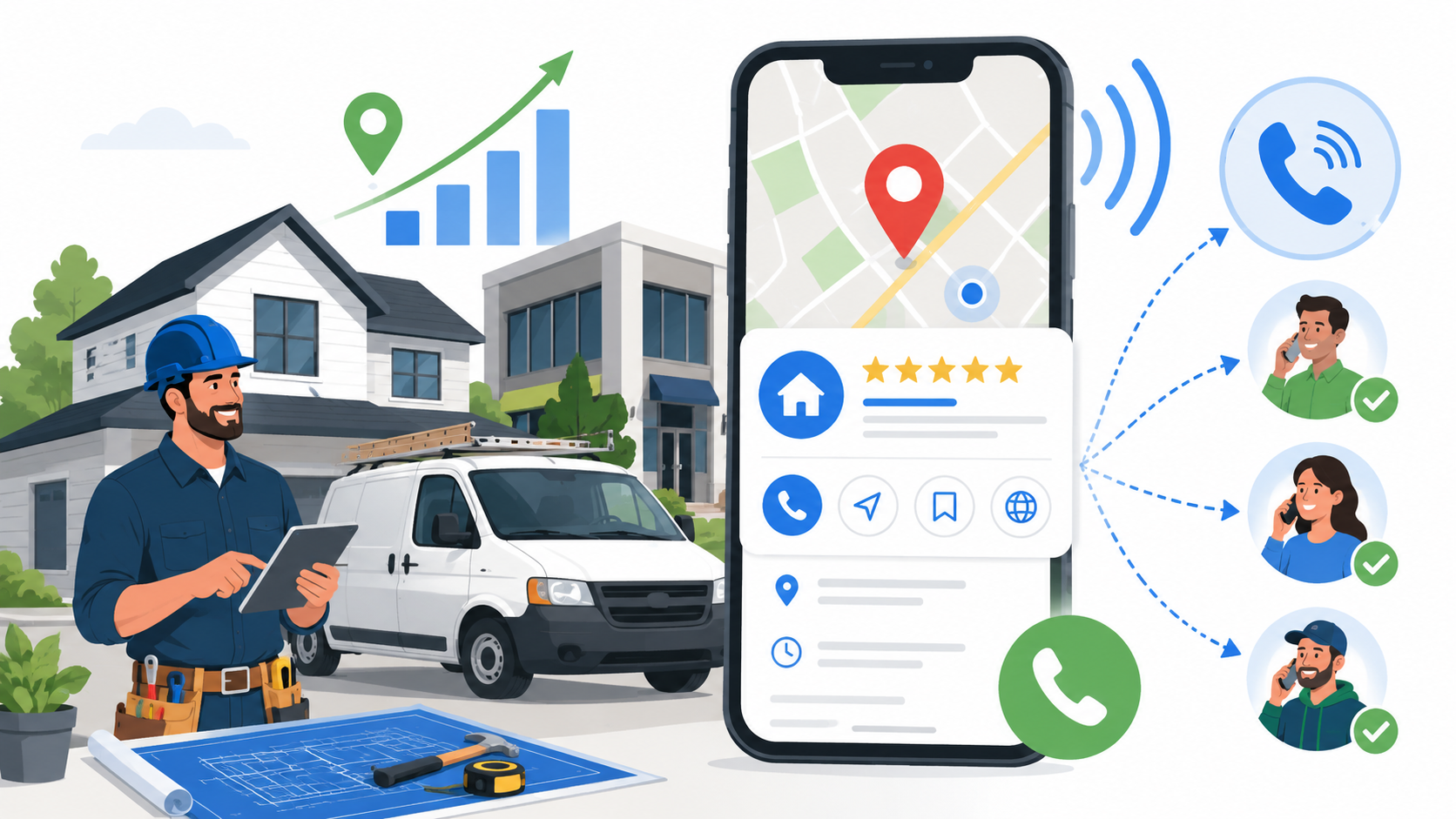


Contractors who rank in Google's local 3-pack get the majority of calls for high-intent searches like "roofer near me" or "AC repair in [city]." Getting there requires a fully optimized Google Business Profile, a consistent presence across local directories, a steady stream of recent reviews, and a website that supports your local authority. Local SEO for contractors is not a one-time setup. It is an ongoing process that compounds over time, and the contractors who invest in it consistently generate more inbound calls, better job quality, and lower customer acquisition costs than those relying on referrals and paid ads alone.
Why Google Maps Dominates Contractor Lead Generation
How the Local 3-Pack Works
When someone searches for a contractor service in their area, Google displays a map with three business listings above the standard organic results. This is the local 3-pack, and it captures roughly 44% of all clicks on the search results page. The three businesses shown there get dramatically more calls and website visits than anything below them, including paid search ads in many cases. For high-intent searches like "emergency plumber" or "licensed electrician near me," the person searching is ready to call, which makes map visibility worth more per impression than almost any other marketing channel.
What Google Uses to Rank Contractors in Maps
Google evaluates three core factors when determining which contractors appear in the local 3-pack: relevance, distance, and prominence. Relevance is how well your profile matches what someone searched for. Distance is how close your business is to the searcher or the location they specified. Prominence is a combination of your review count and rating, the authority of your website, how complete your profile is, and how consistently your business information appears across the web. You cannot control distance, but you can significantly improve relevance and prominence.
Google Business Profile Optimization: The Starting Point for Every Contractor
Completing Every Section of Your Profile
Your Google Business Profile is the single most important asset in your local SEO strategy. A fully completed profile signals to Google that your business is legitimate, active, and trustworthy. The complete guide to Google Business Profile optimization covers every field in detail, but the sections that matter most for contractors are your primary and secondary categories, your service area settings, your services list with descriptions, your business description with local keywords, and your photo library.
Most contractors set up their GBP once and never return to it. That is a mistake. Google rewards profiles that show regular activity. Adding new photos weekly, posting updates at least twice a month, and responding to every review within 48 hours all signal to Google that your business is active and engaged, which directly influences your ranking position.
Choosing the Right Primary Category
Your primary category is the most consequential setting in your entire Google Business Profile. It tells Google what type of business you are, and it determines which search queries you are eligible to rank for. A roofing contractor should use "Roofing Contractor" not "General Contractor." An HVAC company should use "HVAC Contractor" not "Air Conditioning Repair Service" if they want to rank for the broader set of heating and cooling queries. Research which category your top-ranking local competitors are using, because that tells you what Google has already validated as the correct match for those searches.
Setting Up Your Service Area Correctly
Contractors who serve customers at the customer's location rather than at a physical storefront should enable the service area setting in their GBP and hide their physical address. You can add up to 20 service area cities or zip codes. Be specific rather than broad. Adding your entire metro area or surrounding counties dilutes your relevance signal. Instead, list the cities and neighborhoods where you actually work and where you want to rank. A Phoenix-based landscaping company should list specific East Valley and West Valley suburbs where they take jobs, not just "Greater Phoenix."
Google Business Profile Ranking Factors: Priority Guide for Contractors
Not every optimization task has the same impact on your local ranking. The table below ranks the most important GBP factors by their influence on map visibility, so you can prioritize your time and budget accordingly.
Reviews: The Single Biggest Driver of Local Ranking for Contractors
Why Review Velocity Matters More Than Total Count
Google does not just count how many reviews you have. It weights recency heavily, which means a contractor with 40 reviews in the past 12 months will often outrank one with 200 reviews spread over five years. Your goal is not to collect reviews once and stop. It is to build a consistent monthly review volume that signals to Google that your business is actively serving customers right now. For most contractors, requesting a review at job completion, either by text message or a direct link sent immediately after finishing the work, is the most effective method.
How to Generate Reviews Without Violating Google's Guidelines
Google prohibits offering incentives in exchange for reviews, so avoid gift cards, discounts, or any other reward tied to leaving feedback. What you can do is make the review process as frictionless as possible. Create a short link directly to your Google review form using the review link generator in your GBP dashboard, and send it to every customer within 24 hours of completing a job. A simple text message with a direct link converts far better than an email asking customers to "find us on Google." Aim to get above 50 reviews with a rating of 4.5 or higher before investing heavily in paid advertising, because ad traffic converts better when you have strong social proof.
Responding to Reviews the Right Way
Responding to every review, positive and negative, improves your GBP ranking and demonstrates professionalism to prospective customers who read your profile before calling. For positive reviews, keep responses brief and specific rather than using a generic template. For negative reviews, acknowledge the issue without being defensive, offer to resolve it offline, and keep the response under 100 words. A contractor who handles a negative review professionally often earns more trust from readers than one with a perfect rating and no reviews at all.
Citation Building and NAP Consistency
What Citations Are and Why They Matter
A citation is any online mention of your business name, address, and phone number, regardless of whether it includes a link to your website. Search engines use citations to verify that your business is legitimate and that your contact information is consistent. For contractors, the highest-value citation sources are Google Business Profile, Yelp, Angi, HomeAdvisor, the Better Business Bureau, Houzz, Thumbtack, and your local Chamber of Commerce directory. Each one you build or claim reinforces your local authority signal.
Fixing Inconsistent Business Information
A single inconsistency in your business name, address, or phone number across directories can confuse Google's verification process and suppress your rankings. Common problems include using "LLC" in some listings and not others, listing a suite number in some places and omitting it in others, or having an old phone number still active on a directory you forgot about. Audit your citations at least once a year using a tool like BrightLocal or Whitespark, or have your marketing partner run a citation audit as part of your local SEO setup. Cleaning up inconsistencies often produces faster ranking movement than adding new citations.
Your Website's Role in Local SEO for Contractors
Why Your Website and GBP Work as a Unit
Google uses your website to verify and expand what your GBP says about your business. A contractor whose GBP lists roofing, gutters, and siding as services but whose website only mentions roofing is sending a mixed signal. Your website needs dedicated pages for each service you offer and dedicated location pages for each city or region you serve. This is not just good SEO practice. It is how you tell Google what you do, where you do it, and who you serve. The investment in professional web design and development pays dividends across every other marketing channel because your site is the foundation that your GBP, paid ads, and social presence all point back to.
The impact of page structure and user experience on conversion rates is covered in detail in the post on the ROI of UX-driven web design, which is directly relevant to contractor websites where most visitors arrive with high intent and make a call decision within the first 10 seconds.
Location Pages That Actually Rank
A location page is a dedicated page on your website targeting a specific city or area you serve. Done correctly, a location page for "HVAC repair in Scottsdale" can rank independently in organic search results and reinforce your GBP ranking for Scottsdale-area searches. Each location page needs a unique title tag and meta description targeting the city and service, a minimum of 300 words of original content specific to that location, your local phone number, an embedded Google Map, and at least one customer testimonial or project reference from that area. Avoid duplicating the same page across multiple cities with only the city name swapped out. Google recognizes thin duplicate content and will not rank it.
Speed and Mobile Performance
More than 70% of local contractor searches happen on mobile devices, and Google uses mobile page speed as a direct ranking factor. A contractor website that takes more than three seconds to load on a 4G connection loses a significant portion of its traffic before anyone reads a word. Run your site through Google PageSpeed Insights and address any issues flagged as "poor" or "needs improvement" before investing in other optimization tasks. A fast, mobile-optimized site with clear click-to-call buttons and a simple contact form will convert local search traffic dramatically better than a slow, desktop-first site regardless of how well it ranks.
Google Local Services Ads: The Paid Complement to Organic Local SEO
How LSAs Differ from Standard Google Ads
Google Local Services Ads appear above both standard search ads and organic results for contractor service queries, and they operate on a pay-per-lead rather than pay-per-click model. You only pay when a potential customer calls or messages you directly through the ad. LSAs also display a "Google Guaranteed" or "Google Screened" badge, which signals legitimacy to searchers who are evaluating multiple contractors. For most home service contractors, LSAs are the highest-converting form of paid advertising available because they capture searchers at peak intent before they ever reach the organic results.
Using LSAs to Supplement Local SEO, Not Replace It
LSAs produce immediate results but require ongoing budget. The moment you pause your LSA spend, your visibility in that placement disappears. Organic local SEO, by contrast, builds compounding value over time. The strongest contractor marketing programs run LSAs to generate leads immediately while investing in local SEO simultaneously, then gradually shift budget toward organic as rankings improve and the cost per lead from SEO drops below the cost per lead from paid sources. If your overall marketing budget needs calibration before you add LSAs, the framework in the post on how much a local business should spend on marketing gives you a starting point for channel allocation.
The Local SEO Setup Checklist for Contractors
If you are starting your local SEO from scratch or auditing an existing presence, work through this checklist in order. Each item builds on the one before it.
- Claim and verify your Google Business Profile if you have not already done so
- Select the correct primary category and add all relevant secondary categories
- Complete every section of your GBP including services, business description, hours, and attributes
- Upload at least 10 photos of completed jobs and set a reminder to add new ones weekly
- Audit your NAP consistency across Yelp, Angi, BBB, Houzz, and your top 10 directory listings
- Create or update your website with dedicated service pages and location pages for each city you serve
- Build a review request process into your job completion workflow and target 5 or more new reviews per month
- Set up GBP post publishing on a biweekly schedule with job highlights and seasonal offers
- Connect Google Search Console and Google Analytics to your website and monitor local keyword performance monthly
Common Local SEO Mistakes Contractors Make
Using a PO Box or Virtual Office Address
Google requires that businesses with a physical location or service area use a legitimate business address. Using a PO box, a UPS store address, or a virtual office address that Google can identify as a shared commercial location can result in your GBP being suspended without warning. If you operate from your home and do not want to display your home address, enable the service area setting and hide the address rather than substituting a fake or shared address.
Ignoring the Q&A Section
The Q&A section on your Google Business Profile is publicly editable, which means anyone can post a question and anyone can answer it, including your competitors. Many contractors leave this section completely blank, which means fabricated or inaccurate questions may go unanswered. Seed your own Q&A with 5 to 10 common questions you hear from customers, write clear and keyword-rich answers, and check the section monthly to respond to any new submissions.
Keyword Stuffing Your Business Name
Adding keywords to your GBP business name field is against Google's guidelines and can result in suspension. Your business name in your GBP must match your legal business name exactly as it appears on your signage, invoices, and other official materials. The temptation to list your business as "Smith Plumbing - Best Plumber in Phoenix AZ" is understandable, but it is a violation that Google increasingly enforces through manual reviews and user-reported spam flags.
How to Track Whether Your Local SEO Is Working
These are the metrics that indicate real progress in local search visibility for contractors:
- GBP Insights: track phone calls, direction requests, and website clicks from your profile monthly
- Local keyword rankings: monitor your position in the 3-pack for your 5 to 10 most important service and city combinations
- Organic traffic to location and service pages: use Google Analytics to measure month-over-month growth
- Review velocity: track how many new reviews you receive per month and your rolling average rating
- Call tracking: use a dedicated local number on your website and GBP to attribute inbound calls to local SEO specifically
How Long Does Local SEO Take to Work for Contractors?
Local SEO results follow a predictable timeline when the work is done correctly. Here is what to expect at each stage:
- Days 1 to 30: GBP optimizations take effect, profile completeness score improves, photo views increase
- Days 30 to 60: Citation cleanup and new citations begin resolving NAP inconsistencies, early ranking movement for lower-competition queries
- Days 60 to 90: Review velocity builds, GBP posts are indexed, website location pages begin appearing in search
- Months 3 to 6: Meaningful 3-pack movement for primary service categories, measurable increase in GBP calls and clicks
- Months 6 to 12: Compounding gains as review count grows, location pages rank independently, organic leads reduce reliance on paid advertising
Frequently Asked Questions
How do I get my contracting business on Google Maps?
Create a Google Business Profile at business.google.com and complete the verification process, which typically involves receiving a postcard with a verification code at your business address or verifying via phone or email. Once verified, complete every section of your profile including your primary category, service area, services list, business description, hours, and phone number. A complete and verified profile is the minimum requirement to appear in Google Maps results.
How many reviews does a contractor need to rank in the local 3-pack?
There is no fixed threshold, but in most mid-size markets, contractors with 30 or more reviews and a rating of 4.5 or above are competitive for 3-pack placement. In high-competition markets like Phoenix, Dallas, or Miami, you may need 80 to 150 reviews to consistently hold a top-three position for primary service queries. More important than the total number is your review velocity. Generating 5 or more new reviews per month signals recent activity, which Google weights heavily in local rankings.
What is the difference between local SEO and regular SEO for contractors?
Regular search engine optimization focuses on ranking your website in the standard organic results for keywords. Local SEO focuses specifically on ranking in the local 3-pack map results, which appear above organic results for location-based service queries. Local SEO involves optimizing your Google Business Profile, building citations, generating reviews, and creating location-specific website content. Most contractor leads come from local map results rather than standard organic results, which is why local SEO typically has higher priority for service businesses.
Does social media affect my Google Maps ranking?
Social media activity does not directly influence your Google Maps ranking, but it contributes indirectly by driving traffic to your website, increasing brand searches, and building the kind of online presence that Google uses as a prominence signal. A contractor with active social media profiles that regularly generates engagement and links back to their website supports their overall local authority. It also builds the review volume and customer relationships that directly impact local rankings.
Can I do local SEO myself or do I need an agency?
The initial GBP setup, category selection, and basic citation building are tasks most contractors can handle themselves with a few hours of focused work. Where most contractors struggle is maintaining the consistency required for ongoing results: regular photo uploads, GBP posts, review response management, monthly citation audits, and website content updates. If you or someone on your team can commit three to five hours per month to these tasks, DIY local SEO is viable. If not, a local SEO retainer with an agency is almost always more cost-effective than the leads you lose by neglecting it.
How do I rank in a city where I do not have a physical address?
Add the cities where you work to your service area list in your Google Business Profile. You can list up to 20 cities or zip codes. Beyond that, create dedicated location pages on your website for each city you want to rank in, with original content describing your services in that area and any relevant project examples. Reviews from customers in those cities also help, because Google uses reviewer locations as a signal for service area relevance.
How does local SEO for contractors compare to running Google Ads?
Google Ads generate immediate visibility but require ongoing spend. Local SEO builds visibility over three to six months but then produces leads at a much lower cost per acquisition because you are not paying per click. Most contractors benefit from running both simultaneously in the first year, using paid advertising to generate leads while local SEO matures. For a framework on how to split budget between paid and organic channels, the post on how much a local business should spend on marketing covers contractor-relevant allocation percentages.
Start Ranking on Google Maps Before Your Competitors Lock You Out
Local SEO is not a technical mystery. It is a systematic process of signaling to Google that your contracting business is legitimate, active, well-reviewed, and relevant to the searches happening in your service area. The contractors who invest in it consistently, even at a modest budget, outperform those who rely entirely on referrals or paid ads over a two to three year horizon. And unlike paid advertising, the rankings you earn through local SEO do not disappear when you stop writing checks.
The window for establishing local search dominance in most contractor categories is still open, but it is narrowing. Every month a competitor invests in their GBP, builds reviews, and creates location pages is a month they compound their advantage over businesses that have not started. The contractors who begin this work in 2026 will be the ones defending strong positions in 2027 and 2028 while latecomers struggle to break into a top-three map result at all.
Weslo Digital specializes in local SEO for contractors and home service businesses across Phoenix and the Southwest. If you want a clear picture of where your local search presence stands and what it would take to rank in the 3-pack for your primary service categories, get in touch with our team. You can also browse our results for other local service businesses to see what consistent local SEO investment looks like in practice.