Content Repurposing Strategy: How to Turn One Piece of Content Into SEO, Social, Email, and Paid Ads
Learn how to build a content repurposing strategy that transforms one strong idea into SEO content, social posts, videos, email campaigns, and paid ads while keeping your marketing connected and efficient.



Creating more content is not always the answer to getting better marketing results.
Businesses often treat SEO, social media, email marketing, video, and paid advertising as separate channels. That can mean coming up with a new idea for every blog post, another idea for Instagram, something different for an email campaign, and yet another concept when it is time to launch an ad.
The result is a content calendar that demands a constant supply of ideas.
A better approach is to get more value from the strongest ideas you already have.
A content repurposing strategy starts with a valuable core piece of content and intentionally adapts that idea for different platforms, audiences, and stages of the customer journey. A detailed blog article could become short-form videos, social posts, an email sequence, paid ad creative, graphics, and more.
The important word is adapt.
Effective content repurposing is not copying the exact same message and publishing it everywhere. Each channel has a different purpose and audience behavior. The goal is to preserve the central idea while presenting it in the format that makes the most sense wherever your audience encounters it.
What Is a Content Repurposing Strategy?
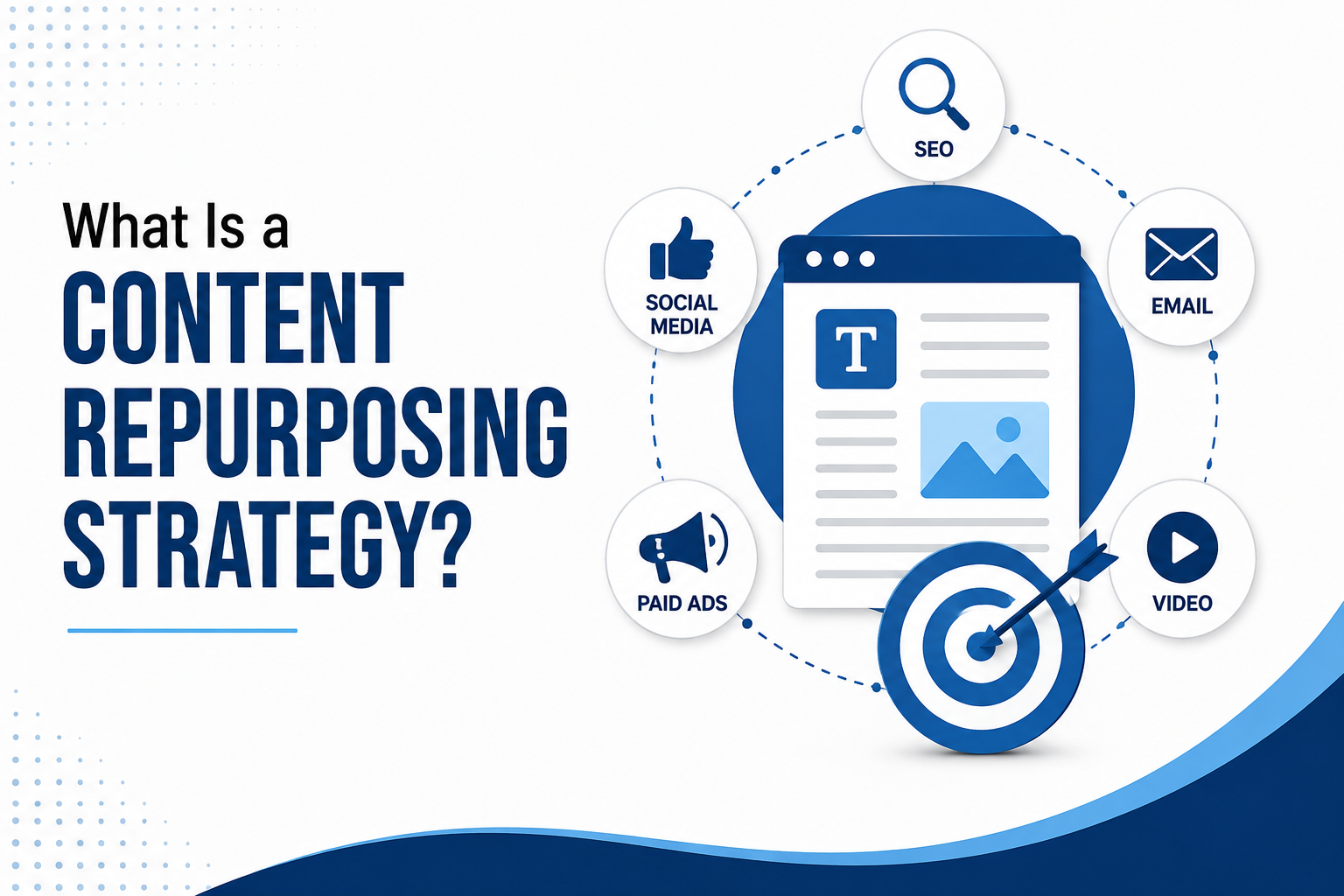
Content repurposing is the process of taking an existing piece of content or central idea and transforming it into additional assets for other formats and marketing channels.
Suppose a landscaping company publishes an in-depth article explaining how homeowners can choose plants for Arizona's climate.
That article could provide material for:
- An Instagram carousel highlighting five drought-tolerant plants
- A short video explaining one common landscaping mistake
- A Facebook post answering a frequently asked customer question
- An email featuring seasonal landscaping recommendations
- A paid social ad promoting a landscape consultation
- A Google Business Profile post featuring one tip
- Several short-form videos for Instagram Reels, TikTok, and YouTube Shorts
One idea has now become numerous pieces of content.
But the original article still matters. It provides the depth behind everything else.
Google's current guidance continues to emphasize creating original, useful, people-first content that provides substantial value instead of producing content primarily to attract search traffic. Google applies the same underlying principle to its newer AI search experiences, where it recommends unique, non-commodity content based on genuine knowledge and experience.
That makes a strong core asset especially valuable. Instead of producing a large volume of disconnected, shallow content, a business can invest in a genuinely useful resource and then strategically distribute its ideas.
Why Content Repurposing Matters More Now
Customer journeys have become increasingly fragmented.
A potential customer might discover a company through an Instagram Reel, search its name on Google, read a blog article, see a retargeting advertisement a few days later, subscribe to an email list, and finally return to request a quote.
No individual channel tells the whole story.
This is one reason businesses benefit from thinking beyond isolated campaigns. A coordinated social media marketing strategy can distribute ideas in formats designed for discovery and engagement, while search content can provide the depth people need when actively researching a problem.
Repurposing connects those experiences.
It can also make content production more efficient. Instead of asking, "What should we post today?" every time a channel needs content, the marketing team can ask, "Which part of our core idea is most useful to this audience on this platform?"
That is a much more focused question.
One Core Asset Can Support the Entire Marketing Funnel
The value becomes clearer when we map one asset across channels.
This is not six unrelated campaigns.
It is one central idea being used for six different marketing jobs.
Businesses that already follow a structured social media content plan can take this further by building repurposing into the planning process from the beginning.
Instead of creating the blog first and wondering what to do with it later, marketers can identify potential videos, social hooks, email topics, and advertising angles while developing the original asset.
Start With a Core Piece of Content Worth Repurposing
Repurposing cannot rescue an idea that was not useful in the first place.
The starting asset should answer a real customer question, demonstrate expertise, solve a problem, explain a decision, or provide information that the target audience genuinely wants.
This also aligns with Google's people-first content guidance, which encourages publishers to consider whether their intended audience would find the content useful even if they came directly to the site rather than discovering it through a search engine.
Strong source assets can include:
- Comprehensive blog posts
- Original videos
- Case studies
- Webinars
- Podcasts
- Customer interviews
- Research or proprietary data
- Detailed guides
- Frequently asked customer questions
For SEO-led campaigns, a comprehensive blog post often makes an effective starting point because the research and structure have already been completed.
The H2s can become individual social topics. Statistics or insights can become graphics. Explanations can become videos. Frequently asked questions can become emails. Problems discussed in the article can become advertising hooks.
One piece of content effectively becomes the source material for the rest of the campaign.
How to Turn One Blog Post Into an SEO Content Ecosystem
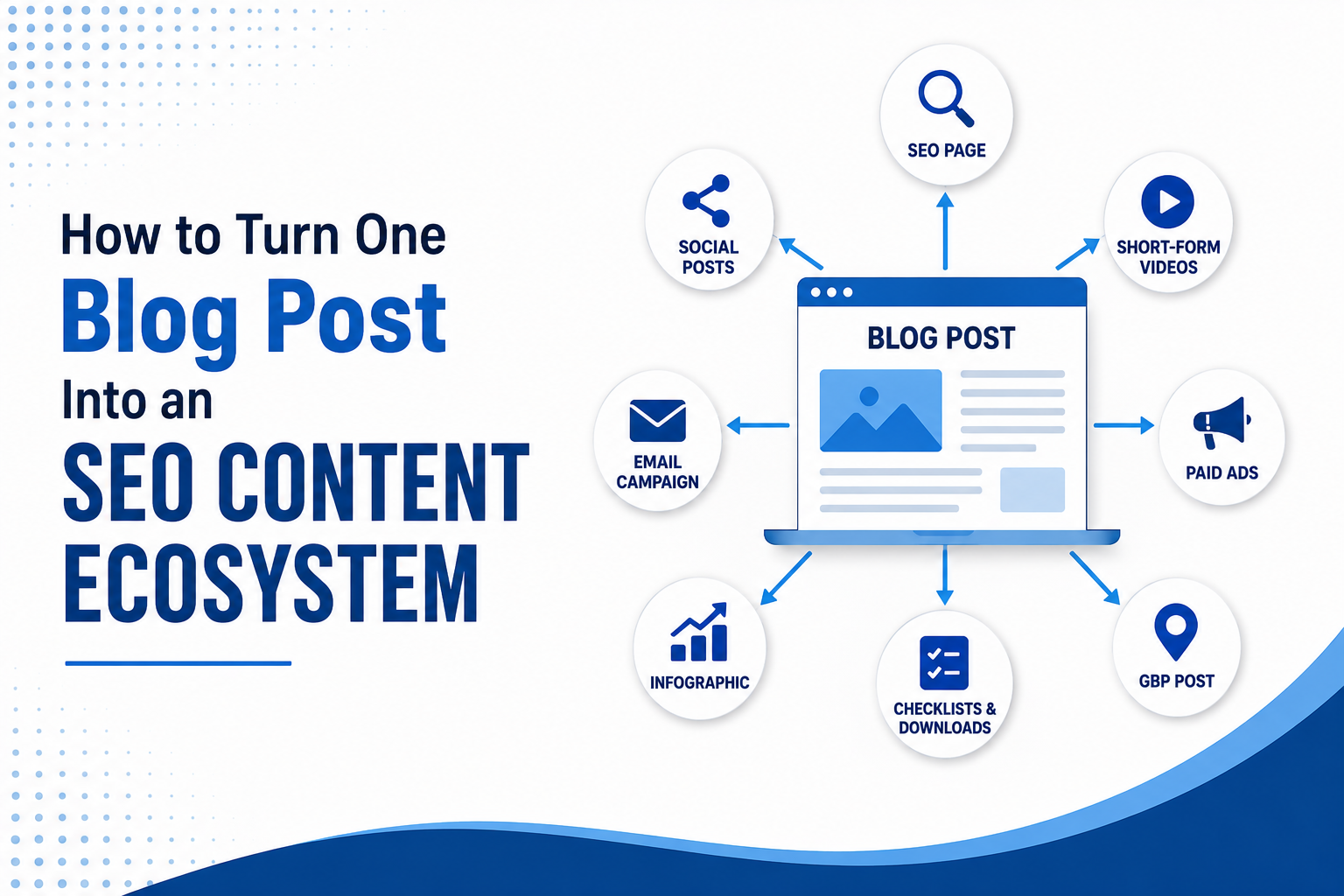
A strong blog post should not be treated as a finished marketing asset once it is published.
It can become the foundation of a much larger content ecosystem.
Start by looking at the individual components of the article. A comprehensive post usually contains several subtopics, customer questions, examples, statistics, recommendations, and explanations. Each of those elements can potentially stand on its own.
For example, imagine a local HVAC company publishes a guide titled:
"7 Signs Your Air Conditioner May Need to Be Replaced"
That single article could generate:
- Seven individual social media posts
- Three or four short-form videos
- An infographic showing common warning signs
- A homeowner checklist
- Two email campaigns
- A Google Business Profile post
- Several paid social advertisements
- A remarketing ad aimed at people who visited the article
- Future supporting blog posts addressing individual AC problems in greater depth
Instead of viewing the blog as one piece of content, think of it as a source library.
This approach can also support a broader search engine marketing strategy because the insights gained from search behavior, paid campaigns, and audience engagement can reveal which parts of the original topic deserve further development.
The process becomes circular.
Search research informs the original content. The original content creates material for other channels. Performance across those channels reveals additional audience interests. Those insights can then inform future search content.
Repurposing Content for Social Media
Social media is one of the most natural places to extend the life of a blog post.
The mistake is trying to summarize the entire article in one social post.
Instead, break the article into individual ideas.
An article with eight meaningful sections could potentially provide eight or more social posts. Each one should focus on a single question, insight, problem, or takeaway.
For example, one section of an article about local SEO might explain why inaccurate business information creates problems for local visibility.
That section could become:
Instagram carousel:
"5 Places Your Business Information Needs to Match"
Facebook post:
"Changed your business phone number recently? Here is why updating your website alone may not be enough."
LinkedIn post:
"Local search consistency is often treated as a technical SEO task, but it is really a customer experience issue."
Short-form video:
"One local SEO mistake that can send customers to the wrong phone number."
The information comes from the same source, but the hook and format change according to the platform.
That is the difference between simply distributing content and actually repurposing it.
Turn Headings Into Social Content Ideas
A simple starting point is to examine every H2 and H3 in the original article.
Ask:
- Could this heading become a standalone social post?
- Is there a useful tip within this section?
- Is there a common mistake that could become a hook?
- Is there a question that could become a video?
- Is there a list that could become a carousel?
- Is there a strong statement that could start a discussion?
This can quickly turn one long article into several weeks of social content.
The approach also makes it easier to maintain thematic consistency. Instead of jumping randomly between unrelated topics, the brand can explore one important subject from several angles.
Use Video to Make Complex Ideas Easier to Consume
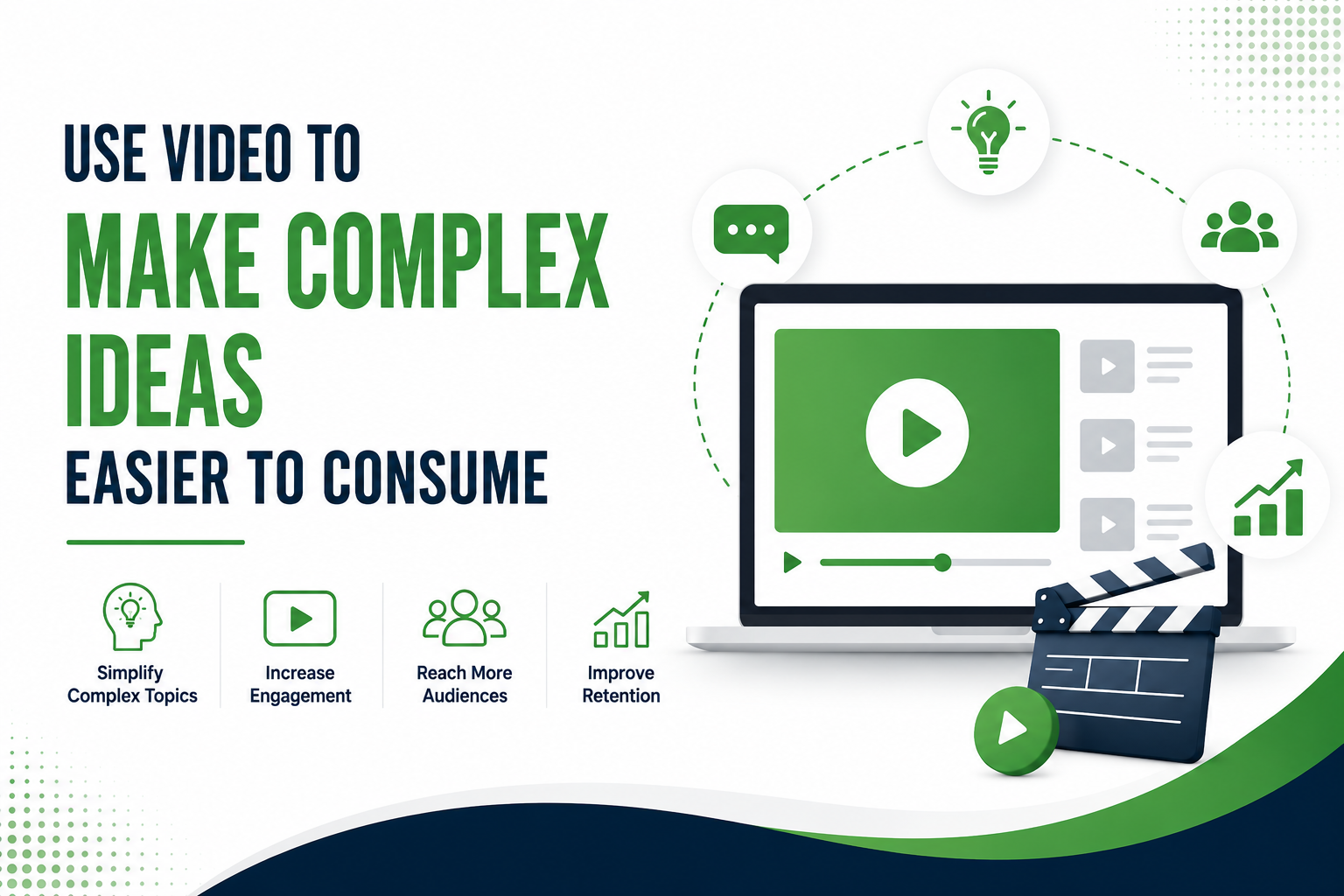
Video adds another layer to a content repurposing strategy because not everyone wants to consume information by reading a long article.
A detailed written explanation might translate into a 30-second demonstration, a one-minute educational video, a customer FAQ video, or a longer discussion.
The important part is not simply reading the blog article into a camera.
Video should reinterpret the idea visually.
For example, suppose a roofing company's blog explains how homeowners can identify storm damage.
One section might become a short video showing three things homeowners can safely look for from the ground. Another could explain when damage warrants a professional inspection. A third could address whether homeowners should contact a roofer or their insurance company first.
The original article provides the expertise and messaging foundation, while video provides another way for people to access that information.
Businesses with access to professional video production and editing can take this further by planning multiple assets during a single shoot.
Rather than filming one video for one platform, a production session could capture:
- A primary long-form video
- Several vertical clips
- Short answers to FAQs
- Customer-facing educational clips
- Behind-the-scenes footage
- B-roll for future advertising
- Still frames for graphics and thumbnails
This creates a reusable content library rather than a single finished video.
Long-Form Video Can Work in Reverse Too
The core asset does not always need to be a blog post.
A podcast, webinar, interview, or long-form video can become the starting point.
A 30-minute expert interview might contain enough material for:
- A written article
- Several short videos
- Quote graphics
- LinkedIn posts
- An email
- A downloadable checklist
- Paid ad creative
The marketing team can extract the strongest ideas, organize them around search intent, and create a comprehensive written resource.
This is particularly useful for businesses where subject matter experts have valuable knowledge but do not have time to write lengthy articles themselves.
Record the expertise first. Build the content ecosystem from it afterward.
Repurpose Content for Email Marketing
Email serves a different purpose from search or social media.
People receiving your marketing emails have usually already had some interaction with the business. They may have subscribed to a newsletter, requested information, downloaded something, purchased previously, or otherwise entered the company's audience.
That means the message can be more direct and relationship-focused.
A comprehensive article can often be broken into several emails instead of being promoted once with a message saying, "Read our latest blog."
Suppose a home remodeling company publishes a guide about planning a kitchen renovation.
The company could build a short email sequence around the article:
Email 1: How to determine a realistic renovation budget
Email 2: The decisions homeowners should make before choosing a contractor
Email 3: Common kitchen remodeling mistakes
Email 4: How long a typical project may take
Email 5: Questions to ask before requesting an estimate
Each email delivers value independently while pointing readers toward the larger topic or an appropriate next step.
This creates more opportunities for the original content to contribute to lead nurturing.
Match the Email to the Customer's Stage
Not every subscriber should receive the same interpretation of an idea.
Someone who has just discovered the brand may need education.
Someone who has already requested an estimate may need reassurance, proof, comparisons, or answers to objections.
A useful way to repurpose content is therefore to map individual sections to stages of the customer journey.
This allows the same core expertise to support different objectives without forcing marketers to invent entirely new subjects for every email.
Turn High-Performing Content Into Paid Advertising Ideas
Paid advertising provides another useful destination for proven content ideas.
Organic content can show marketers what audiences actually care about before advertising dollars are committed.
If a particular social video receives unusually strong engagement, a blog topic generates consistent traffic, or an email produces a high click-through rate, that behavior provides a signal.
The underlying message may be worth testing in advertising.
A paid advertising strategy can therefore benefit from the insights produced by organic content.
Suppose a contractor publishes a video titled:
"3 Signs Your AC Repair Might Not Be Worth the Money."
If that video consistently generates comments, saves, and website visits, the underlying pain point may make a strong advertising concept.
The paid version should not necessarily be identical.
The organic content might educate viewers about all three warning signs. The advertisement could focus on the strongest one and transition into a specific offer or next step.
This is another example of adaptation rather than duplication.
Use Paid Campaigns to Learn What to Repurpose Next
The relationship works in both directions.
Organic content can inform paid campaigns, but paid campaign performance can also reveal what audiences respond to.
If one advertisement consistently outperforms others because it addresses a particular customer problem, that problem may deserve:
- A comprehensive SEO article
- A video series
- An FAQ
- An email campaign
- Several organic social posts
Content repurposing therefore becomes more than a production efficiency tactic.
It becomes a feedback system.
Every channel can generate information that improves the others.
And that becomes particularly powerful when SEO, social media, email, video, and paid media are managed as connected parts of the same strategy rather than separate marketing activities.
Build a Cross-Channel Content Repurposing Workflow
The most effective content repurposing usually happens when it is planned before the original asset is published.
Instead of completing a blog post and then asking how it might be reused, identify repurposing opportunities during the content planning process.
A practical workflow might look like this:
- Choose one core topic based on customer needs, search behavior, business priorities, or proven audience interest.
- Create the primary content asset with enough depth to provide genuine value.
- Identify the strongest individual ideas, questions, examples, and takeaways within it.
- Match those ideas to appropriate marketing channels.
- Adapt the format and hook for each platform.
- Publish and distribute the content over time.
- Measure which topics and formats generate the strongest response.
- Feed those insights into the next round of content.
This prevents content repurposing from becoming an afterthought.
It also gives the marketing team a much clearer production plan.
One article may require significant research and subject matter expertise, but that work can potentially support weeks of marketing activity.
A Practical Content Repurposing Framework for Local Businesses
Local businesses do not necessarily need enormous content teams to use this strategy.
Consider a Phoenix landscaping company that creates an in-depth article about preparing a yard for Arizona's hottest months.
The article could become a campaign like this:
The campaign stays focused on one central subject while meeting potential customers in different places and formats.
For businesses competing within a specific service area, connecting repurposed content with a broader local SEO strategy can also help keep topics aligned with the questions and services that matter to nearby customers. This service URL is confirmed in the supplied sitemap.
Common Content Repurposing Mistakes to Avoid
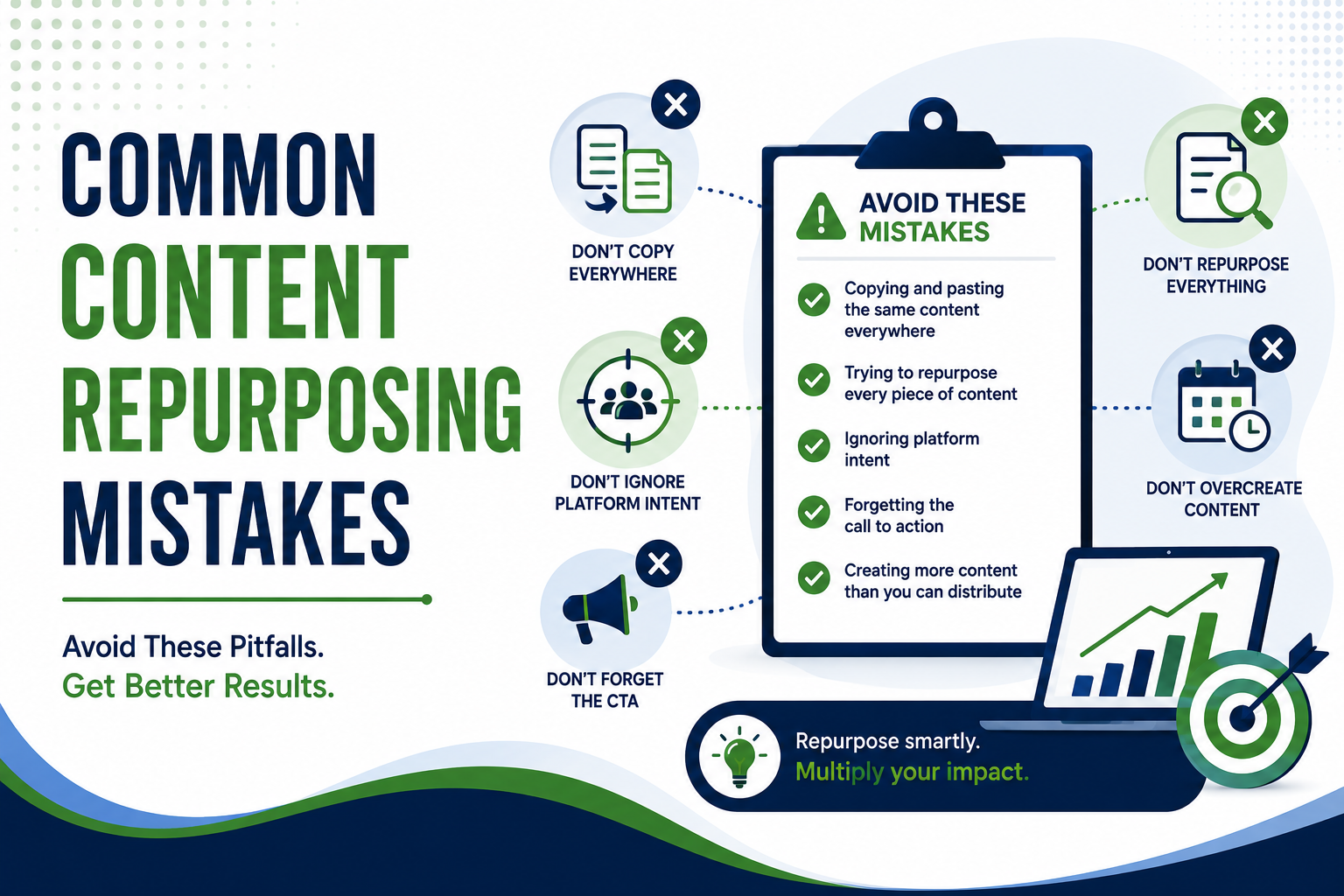
Repurposing content can save time, but efficiency should not come at the expense of quality.
Copying and Pasting the Same Content Everywhere
Each platform has different user behavior.
A 1,500-word article does not become an Instagram strategy simply because several paragraphs are copied into a caption.
Adapt the idea to the channel.
Trying to Repurpose Every Piece of Content
Not every asset deserves a second life.
Prioritize topics that are strategically important, evergreen, timely, frequently asked about, or already performing well.
Ignoring Platform Intent
Someone watching a short video may be looking for a quick answer. Someone reading a detailed search result may want comprehensive information. Someone clicking an advertisement may need a clear reason to act.
Repurposed content should respect those differences.
Forgetting the Call to Action
The appropriate next step can change with the channel.
A blog might encourage readers to explore a service. An educational social post might encourage them to save the information. An email might lead to a consultation. An advertisement might ask for a quote.
Do not automatically attach the same CTA to every asset.
Creating More Content Than You Can Distribute
Repurposing can quickly produce a large inventory.
That does not mean everything needs to be published immediately.
A strong article might generate enough material for several weeks or even months. Build a distribution schedule so useful ideas continue working instead of appearing everywhere at once and disappearing just as quickly.
Frequently Asked Questions About Content Repurposing
What is a content repurposing strategy?
A content repurposing strategy is a planned approach to adapting one core idea or content asset into multiple formats for different marketing channels. For example, a blog article could become social posts, videos, emails, graphics, Google Business Profile posts, and paid advertising concepts.
Is repurposing content bad for SEO?
Repurposing an idea does not inherently harm SEO. The goal is to adapt useful information to different formats and audiences rather than create large quantities of repetitive, low-value content. Your website content should still provide useful, original value to visitors.
What content should I repurpose first?
Start with content that addresses an important customer question, supports a priority service, performs particularly well, demonstrates expertise, or remains relevant over time. Existing high-performing content can be especially useful because you already have evidence that the subject interests your audience.
How many pieces of content can one blog post create?
There is no fixed number. A comprehensive article may contain enough distinct ideas for numerous social posts, several videos, an email sequence, graphics, advertisements, and additional supporting articles. Quality and relevance matter more than maximizing the number of assets.
Should every piece of repurposed content link back to the original article?
No. Linking to the original resource makes sense when it provides a useful next step, but every asset should work naturally within its own platform. Some posts may be designed primarily for awareness, engagement, lead generation, or another goal.
Make Every Strong Idea Work Harder

A business does not necessarily need more disconnected content. It needs to extract more value from the ideas that deserve attention.
A well-planned content repurposing strategy allows one piece of research, expertise, or storytelling to support SEO, social media, email, video, and paid advertising without making every channel feel identical.
Start with something worth saying. Build a substantial core asset around it. Then identify the questions, examples, insights, and stories hidden inside that asset and give each one the format that best fits the audience.
The result is not simply more content.
It is a connected marketing system in which search can inform social, social can inform advertising, advertising can reveal new customer interests, video can extend the reach of expertise, and email can continue the conversation.
When those channels reinforce one another, one strong idea can travel much further than one publication.