The Local Business Guide to Short-Form Video Marketing in 2026
Learn how to build a practical short-form video marketing strategy for your local business using customer questions, educational videos, local content, Reels, TikTok, YouTube Shorts, repurposing, and meaningful performance metrics.



Short-form video has moved well beyond being a social media trend. For local businesses, it has become a practical way to demonstrate expertise, introduce the people behind a company, answer customer questions, showcase products or services, and stay visible across the platforms customers use every day.
The opportunity is not limited to brands with large audiences or dedicated production teams. A plumber can demonstrate why a drain keeps clogging. An HVAC contractor can explain why an air conditioner is struggling during summer. A restaurant can show how a popular dish is prepared. A remodeling company can document a transformation from demolition to finished project. A professional service provider can answer a question that clients ask every week.
Each of these ideas can become a short video that delivers useful information while giving potential customers a reason to remember the business behind it.
The challenge is creating those videos strategically.
Effective short-form video marketing is not about chasing every trend or trying to go viral. Local businesses need a repeatable system that connects video topics, platforms, customer needs, geographic relevance, calls to action, and measurable business goals.
This guide explains how to build that system in 2026.
Why Short-Form Video Matters for Local Businesses in 2026
Local businesses have traditionally relied heavily on search engines, referrals, reviews, websites, and paid advertising to reach potential customers. Those channels remain important, but the way people discover and evaluate businesses continues to expand.
A prospective customer might first encounter a company through a short video rather than its homepage.
They may see a contractor explaining a common repair, a dentist answering a patient question, a landscaper documenting a project, or a restaurant showing a new menu item. The viewer may not need the business at that exact moment, but the interaction can begin building recognition before the buying decision occurs.
That makes short-form video particularly useful for businesses where trust and familiarity influence the final decision.
A well-planned social media marketing strategy can use short-form video to repeatedly put useful information, recognizable people, and real examples of a company’s work in front of potential customers.
Video Makes Expertise Easier to Demonstrate
Businesses frequently claim that they are experienced, knowledgeable, or committed to quality.
Video gives them an opportunity to show it.
Consider the difference between a contractor writing, “We provide professional installations,” and recording a 45-second video explaining one detail homeowners should check before choosing an installation company.
The second approach gives the customer something tangible on which to judge expertise.
The same principle works across industries. Attorneys can explain common misconceptions. Realtors can discuss neighborhood considerations. Auto repair shops can demonstrate warning signs. Med spas can explain what customers should expect from a treatment. Home service companies can show maintenance tips or explain why a particular problem occurs.
Educational content gives the business an opportunity to be useful before asking for the sale.
Short Video Reduces the Commitment Required From the Viewer
Long-form videos remain valuable when a topic requires depth, but not every customer question needs ten minutes to answer.
Short-form video works particularly well when one useful idea can be communicated quickly.
A business can focus each video on a single question:
Why is my AC running but not cooling?
How often should I clean my gutters?
What causes low water pressure?
What should I look for during a home inspection?
How do I know whether this repair can wait?
Each question creates a clear reason to watch while preventing the video from becoming overloaded with information.
The result is a content format that can fit naturally into the way people browse social platforms while still delivering genuine value.
Short-Form Video Is a Format, Not the Strategy
One of the biggest mistakes businesses can make is treating “make more videos” as a marketing strategy.
It is not.
Video is the format. Strategy determines what the business says, who the content is for, why someone should care, where the video should appear, and what should happen after someone watches it.
A local business posting random trends one week, an advertisement the next, and an unrelated behind-the-scenes clip the week after may technically be producing content, but the audience receives no consistent reason to follow or remember the company.
A stronger approach starts with customer intent.
Ask:
What questions do customers repeatedly ask?
What problems make them contact the business?
What makes them hesitate before purchasing?
What misconceptions does the sales team repeatedly correct?
What aspects of the service are difficult to explain with text alone?
What transformations are visually compelling?
What expertise does the business possess that customers genuinely need?
Those answers create the foundation for a sustainable short-form video strategy.
They also make production easier. Instead of sitting down each week and asking, “What should we post?”, the business can build a library of proven topics based on actual customer conversations.
This is where short-form video can connect particularly well with a broader content repurposing strategy. One customer question can become a short video, an FAQ, a social post, part of a longer article, an email topic, or even an advertising angle.
The business does not necessarily need more ideas. It needs a better system for extracting more value from the ideas it already has.
What Should a Local Business Film?
The easiest way to make short-form video marketing sustainable is to stop treating every video as a completely new creative project.
Most local businesses already have dozens of potential topics hidden inside their daily operations. Customer questions, consultations, service calls, projects, products, reviews, employee expertise, and common mistakes can all become useful videos.
The key is organizing those ideas into repeatable content categories.
Answer Frequently Asked Questions
Start with the questions employees hear repeatedly.
If customers ask the same question every week, there is a strong chance other potential customers are wondering about it too.
Examples might include:
- How long does this service take?
- What does the process involve?
- How much maintenance is required?
- When should something be repaired instead of replaced?
- What should customers do before an appointment?
- What warning signs should they watch for?
- What affects the cost of a service?
Record one short video for each question rather than trying to cover an entire subject in one post.
This approach creates useful content while reducing the pressure to constantly invent new topics. A structured social media content plan can then organize those questions into a consistent publishing schedule.
Show the Work
Local businesses often have an advantage over larger brands because their everyday work can provide highly specific visual content.
A contractor can document a transformation. A landscaper can show the progression of a project. A restaurant can show food preparation. A mechanic can demonstrate a worn component beside a replacement. A retailer can demonstrate a product.
Before-and-after content is especially useful when the improvement can be understood visually.
The video should still provide context. Instead of simply showing the finished result, explain what the customer needed, what was done, and why a particular approach was chosen.
That turns a visual transformation into an educational customer story.
Show the People Behind the Business
Customers do not always choose between products or services alone. They often choose between businesses they believe they can trust.
Short-form video gives owners, technicians, consultants, salespeople, and other team members an opportunity to become familiar before the customer ever makes contact.
This does not require elaborate employee profiles. A team member can answer a question, explain part of a process, demonstrate equipment, or offer one practical tip.
Over time, repeated exposure can help potential customers associate real people with the company.
Build Short Videos Around a Simple Structure
A useful short video does not need a complicated script, but it should have direction.
A practical structure is:
Hook → Value → Proof or Explanation → Next Step
Start With a Specific Hook
The opening should quickly communicate why the viewer should continue watching.
Compare:
“Today we’re going to talk about air conditioners.”
with:
“If your AC is running all day but your house still feels warm, check these three things.”
The second opening establishes a recognizable problem immediately.
Useful hooks can begin with a question, mistake, warning sign, misconception, customer problem, or desired result.
Examples include:
“Three signs your water heater may be nearing the end of its life.”
“Before you hire a remodeling contractor, ask this question.”
“Here is why your lawn can still look dry after regular watering.”
“Most homeowners overlook this before replacing their HVAC system.”
The hook should lead naturally into the content rather than making a promise the video cannot deliver.
Deliver One Clear Idea
Short-form video usually becomes weaker when businesses try to fit an entire article into 30 or 60 seconds.
Choose one takeaway.
If the topic is too broad, turn it into a series.
For example, “How to maintain your HVAC system” could become individual videos about filters, thermostats, outdoor units, airflow, maintenance schedules, and warning signs.
This gives the audience clearer information while giving the business more content from the same subject.
Businesses that need a more polished approach for demonstrations, testimonials, brand videos, or reusable campaign assets can also combine everyday short-form content with professional video production and editing.
TikTok, Instagram Reels, and YouTube Shorts Are Not Identical
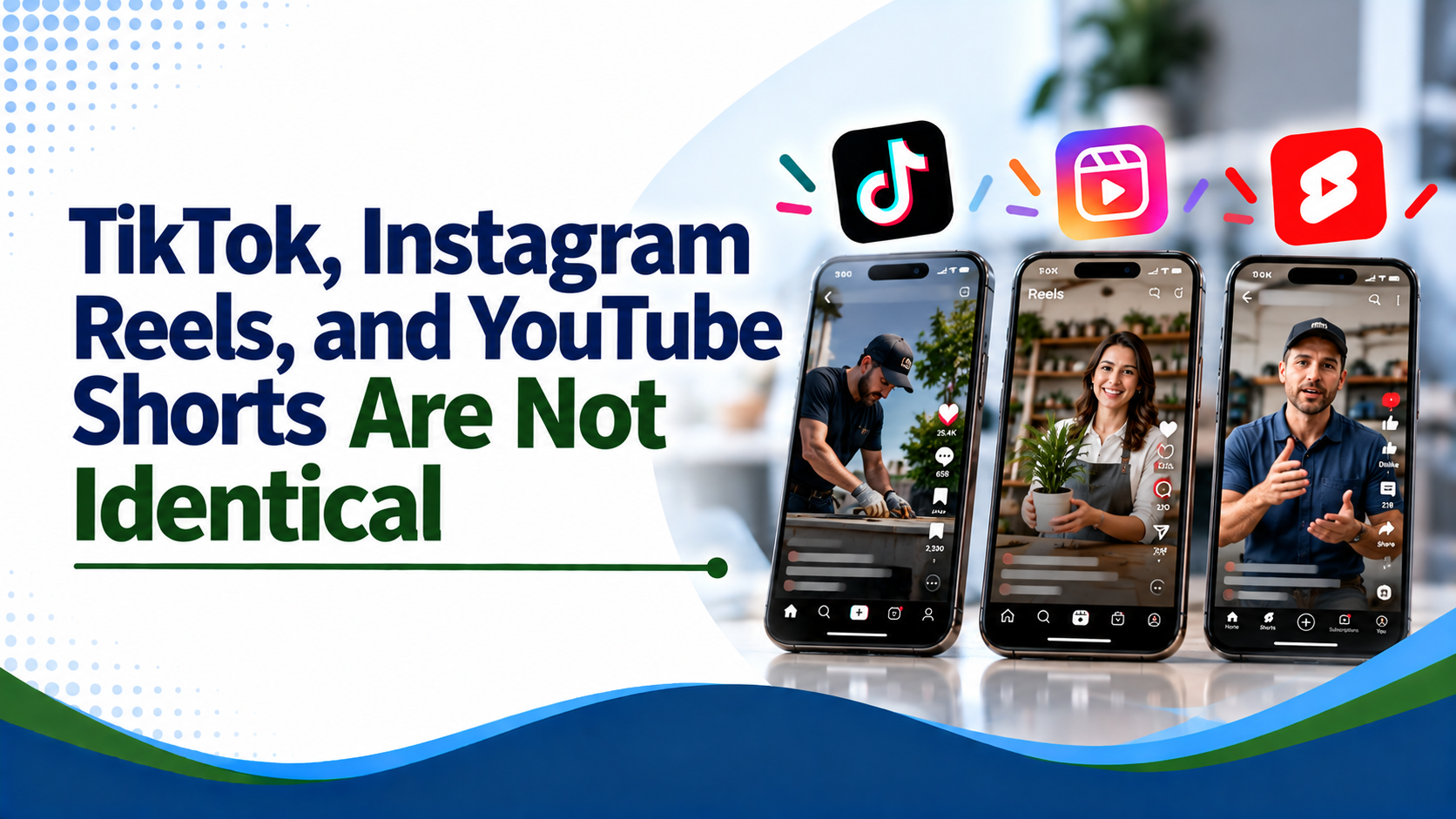
A business does not necessarily need a completely different video for every platform, but it should understand that platforms are not interchangeable.
Instagram Reels
Instagram can work particularly well when video is part of a broader visual presence that includes photos, Stories, carousels, direct messages, and profile information.
For local businesses, Reels can showcase work, answer questions, introduce employees, highlight customer experiences, and provide educational tips.
TikTok
TikTok tends to reward content that feels direct and native to the platform. Educational explanations, demonstrations, storytelling, reactions, and personality-driven content can all fit naturally.
Local businesses should resist the assumption that they need to participate in every trending sound or format. A useful explanation delivered by someone who genuinely understands the subject can be more relevant to the right potential customer than participation in an unrelated trend.
YouTube Shorts
YouTube Shorts gives businesses another way to distribute concise video while participating in the larger YouTube ecosystem.
This can be especially useful when a business also creates longer educational videos. A detailed topic can generate several Shorts, while individual Shorts can introduce subjects that deserve longer explanations.
The goal is not to determine one universal “best” platform. It is to identify where the business can consistently reach the people it wants to influence and create a manageable distribution process.
Make Short-Form Video Locally Relevant
For a local business, one thousand relevant views from people within its market may be more valuable than one hundred thousand views from people who could never realistically become customers.
That changes how success should be approached.
Businesses can introduce local relevance naturally through:
- Neighborhood or city references
- Local weather and seasonal conditions
- Regional customer concerns
- Local projects
- Community events
- Service-area-specific advice
- Questions frequently asked by local customers
A Phoenix landscaping company might discuss plants that handle extreme summer conditions. An Idaho HVAC contractor might discuss preparing equipment for seasonal temperature changes. A Michigan home improvement company might explain how local winter conditions affect an exterior feature.
Local relevance should serve the content rather than being inserted unnaturally.
Short-form video can complement a broader local SEO strategy, but it should not replace foundational assets such as an optimized website, accurate business information, service pages, reviews, and a well-managed Google Business Profile.
Turn One Video Into Multiple Marketing Assets
Producing a useful video takes time, which is why businesses should think beyond a single post.
Suppose a plumbing company records a video explaining three reasons a drain repeatedly clogs.
That original idea could potentially become:
- An Instagram Reel
- A TikTok video
- A YouTube Short
- A website FAQ
- A section within a drain-cleaning article
- A Google Business Profile post
- A short email
- A paid social creative
- A longer educational video
The core insight remains the same, but its presentation changes for each channel.
This approach makes content production more efficient and helps create consistency across marketing channels.
Organic Video Can Also Reveal Paid Advertising Ideas
Organic short-form content can provide useful information about what attracts audience attention.
If videos addressing a particular problem repeatedly generate strong engagement, saves, comments, or inquiries, the underlying message may deserve further testing in advertising.
A successful educational video might be adapted into:
- A problem-and-solution ad
- A customer testimonial ad
- A service demonstration
- A before-and-after ad
- A frequently asked question ad
- A retargeting creative
This does not mean that a popular organic video will automatically become an effective advertisement. Organic and paid distribution operate differently. However, organic content can help businesses identify topics, hooks, questions, and customer concerns worth testing through paid advertising.
A Practical Short-Form Video Content Mix
Publishing the same type of video repeatedly can make a feed predictable. Local businesses can create variety without abandoning their core message by rotating through several content categories.
The objective is not to publish each category equally. Businesses should identify which formats best match their services, customers, resources, and marketing goals.
Make Production Sustainable
A video strategy fails if the production process requires more time than the business can consistently provide.
Batching can help.
Instead of recording one video every time a post is due, choose several topics and record them during one session. A business might prepare six customer questions, record six concise answers, and create several weeks of source material in a single session.
A simple workflow might look like:
Collect questions → Choose topics → Prepare hooks → Record in batches → Edit → Schedule → Repurpose
Businesses should also create repeatable formats. If “60-Second Service Tip,” “Ask Our Technician,” or “Before and After” works well, keep using it.
Consistency in format can reduce production effort while making the content more recognizable.
Do Not Overproduce Every Video
Production quality matters, but quality does not always mean complexity.
Clear audio, usable lighting, a stable image, readable captions, and a focused message can matter more than elaborate transitions or cinematic effects.
Highly produced videos have an important role in brand campaigns, advertising, website content, testimonials, and major company stories. Everyday short-form content can often be simpler.
The appropriate production level depends on the purpose of the video.
A quick expert answer recorded at a jobsite should not necessarily look like a polished brand commercial. Trying to make every post look like one can make content production too expensive and slow to sustain.
Measure More Than Views
Views are easy to see, but they do not tell the entire story.
A local business ultimately needs its marketing to contribute to business outcomes.
Useful short-form video metrics can include:
- Watch time
- Completion rate
- Saves
- Shares
- Comments
- Profile visits
- Website visits
- Direct messages
- Calls
- Form submissions
- Leads
- Booked appointments
- Sales
The importance of each metric depends on the purpose of the video.
An educational video designed to reach new audiences might be evaluated partly through watch time and shares. A service video with a strong call to action should be evaluated more closely against website visits and inquiries.
Businesses should also look for patterns across multiple videos rather than overreacting to a single post.
If videos answering customer questions consistently outperform company announcements, create more customer-question content. If before-and-after videos generate qualified inquiries, expand that format.
Measurement should influence the next round of content.
Common Short-Form Video Marketing Mistakes
Several mistakes can prevent businesses from getting meaningful value from video.
Chasing Virality Instead of Relevance
A large view count can look impressive without producing meaningful business results.
Local businesses should prioritize reaching and influencing potential customers rather than attracting the largest possible audience.
Making Every Video a Sales Pitch
Customers are unlikely to repeatedly watch content that does nothing except promote the company.
Educational, useful, entertaining, or interesting content can earn attention before a direct offer is introduced.
Posting Without a Clear System
Random publishing makes it difficult to learn what works and difficult to maintain consistency.
Create repeatable content categories, establish a manageable schedule, and review performance regularly.
Ignoring the Next Step
Not every video requires an aggressive CTA, but viewers should have a clear path when they want more information.
That may mean visiting a service page, viewing another video, following the account, calling the business, requesting an estimate, or sending a message.
Build a Video System That Can Keep Working

Short-form video marketing in 2026 does not require local businesses to become entertainment companies.
It requires them to recognize that the expertise, questions, projects, customer experiences, and everyday moments already happening inside the business can become valuable marketing material.
Start with what customers genuinely want to know. Create videos around one clear idea at a time. Use recognizable formats. Adapt useful content across platforms. Repurpose strong ideas instead of constantly starting over. Then measure whether that attention is moving people closer to becoming customers.
The businesses that benefit most from short-form video are unlikely to be those that chase every new trend. They will be the businesses that develop a practical system they can continue using month after month.
When short-form video becomes part of a connected marketing strategy rather than an isolated social media task, each recording can do more than generate views. It can educate customers, demonstrate expertise, strengthen familiarity, support search and social discovery, provide material for advertising, and create additional opportunities for the right local audience to find and trust the business.