How to Turn Customer Reviews Into SEO, Ads, and Social Media Content
Customer reviews can do more than build trust. Learn how a review marketing strategy can turn authentic customer feedback into SEO content, social media posts, paid advertising ideas, testimonials, videos, and valuable customer insights.



Customer reviews are usually treated as reputation assets. A customer leaves five stars, the review appears on Google or another platform, and the business hopes prospective customers see it.
That is valuable, but it is only the beginning.
Reviews can also become a rich source of marketing insight. They reveal how customers describe their problems, what they value about a service, what concerned them before buying, and what made the experience worth recommending.
A strong review marketing strategy puts those insights to work.
Instead of allowing a great customer story to sit on a review platform, businesses can use authentic feedback to strengthen SEO content, create social media posts, develop advertising concepts, improve service pages, answer common questions, and identify messages that resonate with potential customers.
The goal is not to copy every five-star review across every channel. It is to understand what customers are saying and turn those insights into useful marketing without losing the authenticity that made the feedback valuable.
Your Best Marketing Content May Already Be Written
Marketing teams spend considerable time trying to understand what customers want to hear.
They research keywords, develop personas, brainstorm advertising hooks, create social calendars, and rewrite website copy.
Meanwhile, existing customers may already be explaining exactly what matters to them.
Consider this hypothetical HVAC review:
“Our AC stopped working during one of the hottest weeks of summer. They came out quickly, explained what was wrong without pressuring us, gave us repair options, and had the house cooling again that afternoon.”
That review contains much more than a positive rating.
The customer identified a problem: the AC stopped working during extreme heat.
They identified a priority: fast service.
They revealed a concern: being pressured into making a decision.
They highlighted a positive experience: receiving clear explanations and options.
Finally, they described the outcome: cooling was restored quickly.
Each insight could inform marketing.
The AC problem might inspire an SEO article. The concern about pressure could influence website copy. The quick response could become a social story. The experience could inspire advertising built around responsive service and clear communication.
One review has suddenly produced several useful ideas.
This approach complements a broader content repurposing strategy. Instead of continually starting from a blank page, marketers can identify strong source material and adapt its underlying ideas for different channels.
What Is Review Marketing?

Review marketing is the strategic use of genuine customer feedback to support broader marketing efforts.
It is useful to distinguish it from related activities.
Review generation focuses on encouraging eligible customers to provide genuine feedback.
Reputation management focuses on monitoring reviews, responding appropriately, and understanding customer perception.
Review marketing asks a different question:
What can we learn from customer feedback, and how can those insights improve our marketing?
That could mean using a relevant testimonial on a service page, identifying language that improves website copy, turning an experience into a social story, or using recurring concerns to create educational content.
For local businesses, this is particularly valuable because customers frequently describe services in practical terms.
A plumbing customer might mention a recurring drain backup. A remodeling customer might discuss communication during construction. An HVAC customer might emphasize fast scheduling.
Those comments provide information about what customers actually value and can help make local SEO content more closely aligned with real customer needs.
Find the Stories Hidden Inside Your Reviews
One common review marketing mistake is looking only for impressive quotes.
A marketer finds a sentence such as “Amazing company, highly recommend,” places it on a graphic, and considers the review repurposed.
Testimonial graphics can be useful, but detailed reviews often provide far more value.
Instead of asking only, “Which sentence can we quote?”, ask:
“What is this customer telling us about the buying experience?”
Problems Customers Mention
Look for the situation that caused the customer to seek help.
Examples include:
- An AC system that stopped cooling
- A clogged drain that kept returning
- A website generating traffic but few leads
- A roof leaking after a storm
- A remodeling project becoming difficult to manage
These problems can become content topics because they originate in genuine customer experiences.
If similar issues repeatedly appear in reviews, customers may need more information about them before contacting the business.
Benefits and Outcomes Customers Value
Businesses often market features because features are easy to describe. Customers frequently remember outcomes instead.
They may praise fast responses, clear communication, convenient scheduling, improved comfort, better results, or having a persistent problem finally solved.
Those patterns can reveal which benefits deserve greater emphasis.
A company may believe price is its strongest selling point while customers repeatedly praise communication. Another may emphasize technical expertise while customers consistently talk about convenience.
That difference is valuable marketing intelligence.
Objections and Concerns
Positive reviews can reveal objections as effectively as negative feedback.
Look for comments such as:
“I was worried this would be expensive, but...”
“I wasn't sure whether we needed a replacement...”
“We had never hired an agency before...”
These statements reveal concerns customers had before buying.
Businesses can address recurring concerns through FAQs, service pages, videos, sales conversations, social posts, and advertising instead of waiting for prospects to raise them individually.
Words Customers Repeatedly Use
Patterns across multiple reviews are often more useful than a single comment.
Do customers repeatedly describe the company as responsive? Do they mention communication, professionalism, cleanliness, friendliness, convenience, or reliability?
Recurring themes help businesses understand the reputation they are actually creating.
Businesses should not instruct customers to use particular keywords or manufacture themes. The value comes from identifying patterns customers voluntarily express.
Turn Customer Reviews Into SEO Content

Reviews can be useful for SEO because search optimization begins with understanding what people want to know.
Keyword research provides one view of demand. Search performance data provides another. Customer reviews provide the language of people who experienced the problem, evaluated their options, made a purchase, and saw the outcome.
That makes reviews valuable voice-of-customer research.
The goal is not to copy review phrases into pages simply because they contain keywords. Instead, reviews can reveal needs that deserve better content.
Mine Reviews for Customer Language
Review a meaningful sample of recent feedback and categorize recurring ideas.
Look for:
- Problems customers describe
- Questions or uncertainty
- Services customers mention
- Benefits they praise
- Objections they overcame
- Outcomes they experienced
Then translate those observations into marketing opportunities.
A recurring problem may suggest a blog topic. A common question could become an FAQ. A frequently praised benefit might deserve stronger service-page messaging.
The important step is moving from review quote to customer insight.
Strengthen Service Pages With Relevant Proof
A service page explains what a business does. Customer feedback can demonstrate what receiving that service is actually like.
Suppose a water heater page explains installation and replacement. Multiple reviews independently praise technicians for explaining options, arriving on time, and leaving the work area clean.
Those experiences may strengthen the page because they address concerns potential customers have before scheduling.
Relevant testimonials can support service claims, but reviews can also expose information the page is missing.
If customers consistently praise something the website barely mentions, marketers should consider whether that benefit deserves more attention.
Turn Customer Questions Into Content
Reviews often reveal questions even when customers do not phrase them as questions.
Consider:
“I thought the whole system would need replacing, but the technician explained that it could still be repaired.”
That suggests an obvious question:
Should I repair or replace my system?
Other customers may mention uncertainty about price, financing, timelines, or whether a particular service will solve their problem.
Those information gaps can become FAQs, blog topics, service-page sections, videos, or Google Business Profile content.
This approach helps businesses combine keyword research with questions expressed by actual customers.
Turn Customer Reviews Into Social Media Content
Social media is an obvious place to repurpose reviews, but continuously posting screenshots of five-star ratings quickly becomes repetitive.
A stronger social media marketing strategy uses reviews as starting points for different content formats.
Create Better Testimonial Graphics
Choose statements that communicate something meaningful.
Compare:
“Great company! Five stars!”
with:
“They explained every option clearly and never pressured us into replacing something that could still be repaired.”
The second quote communicates something about the customer experience.
Graphics should remain easy to read and faithful to the customer's original meaning. Shortening a review for design purposes should never materially change what the customer said.
Turn Reviews Into Customer Stories
Detailed reviews can become miniature stories.
For example:
The Problem: A homeowner's AC stopped cooling.
The Concern: They worried the entire system needed replacement.
The Experience: A technician diagnosed the issue and explained repair options.
The Outcome: Cooling was restored without an unnecessary replacement.
This structure provides useful context before the reader even reaches the testimonial.
Build Carousels and Videos
The same experience could become a carousel:
Slide 1: What happens when your AC suddenly stops cooling?
Slide 2: A customer faced exactly that problem.
Slide 3: Their biggest concern was needing a complete replacement.
Slide 4: An inspection identified a repairable problem.
Slide 5: Cooling was restored.
Reviews can also inspire short-form video without appearing directly in the video.
If customers repeatedly ask whether to repair or replace an AC system, the business might create:
“3 Signs Your AC May Be Repairable Instead of Needing Replacement.”
Professional video production and editing can expand review-driven ideas into customer testimonials, employee explanations, before-and-after stories, and educational videos.
Repurposing reviews does not mean every asset needs to look like a review. Sometimes the greatest value is the idea hidden inside it.
Turn Customer Reviews Into Paid Ad Creative

Advertising teams constantly need messages that attract attention and encourage action.
Reviews can provide clues about both.
Internal marketing may emphasize years in business, certifications, equipment, or technical expertise. Customers may care more about whether someone answers quickly, arrives as promised, explains options clearly, and solves the problem.
Review marketing helps advertisers understand which benefits customers remember.
Build Review Quote Ads
Where appropriate, genuine feedback can provide social proof in advertising.
For example:
AC Problems During Arizona Heat?
★★★★★
“Fast response, clear explanation, and our house was cooling again that afternoon.”
Schedule AC Service Today
The customer's experience supports the message without requiring exaggerated claims.
Businesses should ensure testimonial use follows applicable advertising requirements and platform policies and that necessary permissions are obtained.
Turn Customer Outcomes Into Advertising Angles
Reviews can influence ads even when they are not directly quoted.
If customers repeatedly praise fast responses, clear explanations, straightforward pricing, and clean work areas, those themes provide advertising concepts worth testing.
One campaign might emphasize communication. Another could focus on convenient scheduling. Another could address uncertainty about repair costs.
This creates a useful connection with paid advertising: customer feedback generates informed creative ideas, while campaign performance reveals which messages drive action.
One Review Can Become an Entire Content Ecosystem
The efficiency of review marketing becomes clear when businesses stop assuming one review should produce only one post.
A detailed experience might support:
Not every review should become all of these assets.
The framework simply helps marketers recognize opportunities instead of automatically duplicating the same testimonial across every channel.
Protect Authenticity When Repurposing Reviews
Customer reviews are persuasive because they originate with customers.
Over-editing them can remove what makes them credible.
Businesses should avoid rewriting feedback to make it more enthusiastic, adding claims the customer did not make, taking statements out of context, or presenting a composite statement as though it came from one individual.
When quoting someone directly, preserve the original meaning.
If using customer names, photographs, videos, or other identifying information beyond what a platform permits, determine what permission is appropriate. Advertising and endorsement requirements may also apply depending on how testimonials are collected and used.
Authenticity is not merely a compliance consideration. It is what gives customer feedback its marketing value.
Build a Repeatable Review-to-Content Workflow
Effective review marketing should not require starting from scratch each month.
A simple workflow is:
Collect → Analyze → Categorize → Repurpose → Publish → Measure
Collect and Analyze
Bring together legitimate feedback from platforms relevant to the business.
Instead of immediately searching for five-star quotes, ask:
- What problem did the customer have?
- What mattered most?
- What nearly prevented them from buying?
- What impressed them?
- What outcome did they value?
- Which themes appear repeatedly?
These questions turn reviews into research.
Categorize and Repurpose
Organize useful feedback by service, customer concern, experience, or outcome.
Then choose the marketing format that best fits the insight.
A detailed problem may become a blog.
A strong sentence may become a testimonial.
A repeated question may become an FAQ.
A visual transformation might become a social carousel.
A compelling customer journey could become a video or case study.
The format should follow the insight.
Publish and Measure
Adapt the idea for each channel instead of copying identical content everywhere.
SEO content should answer search intent comprehensively. Social content should communicate quickly. Paid advertising needs a focused message. Service-page testimonials should support the surrounding content.
Then measure results.
Monitor relevant organic visibility and leads for SEO content, engagement and inquiries for social content, and conversions, lead quality, and acquisition costs for advertising.
Measurement helps identify which customer insights resonate beyond the original reviewer.
Use Customer Feedback to Improve the Marketing System
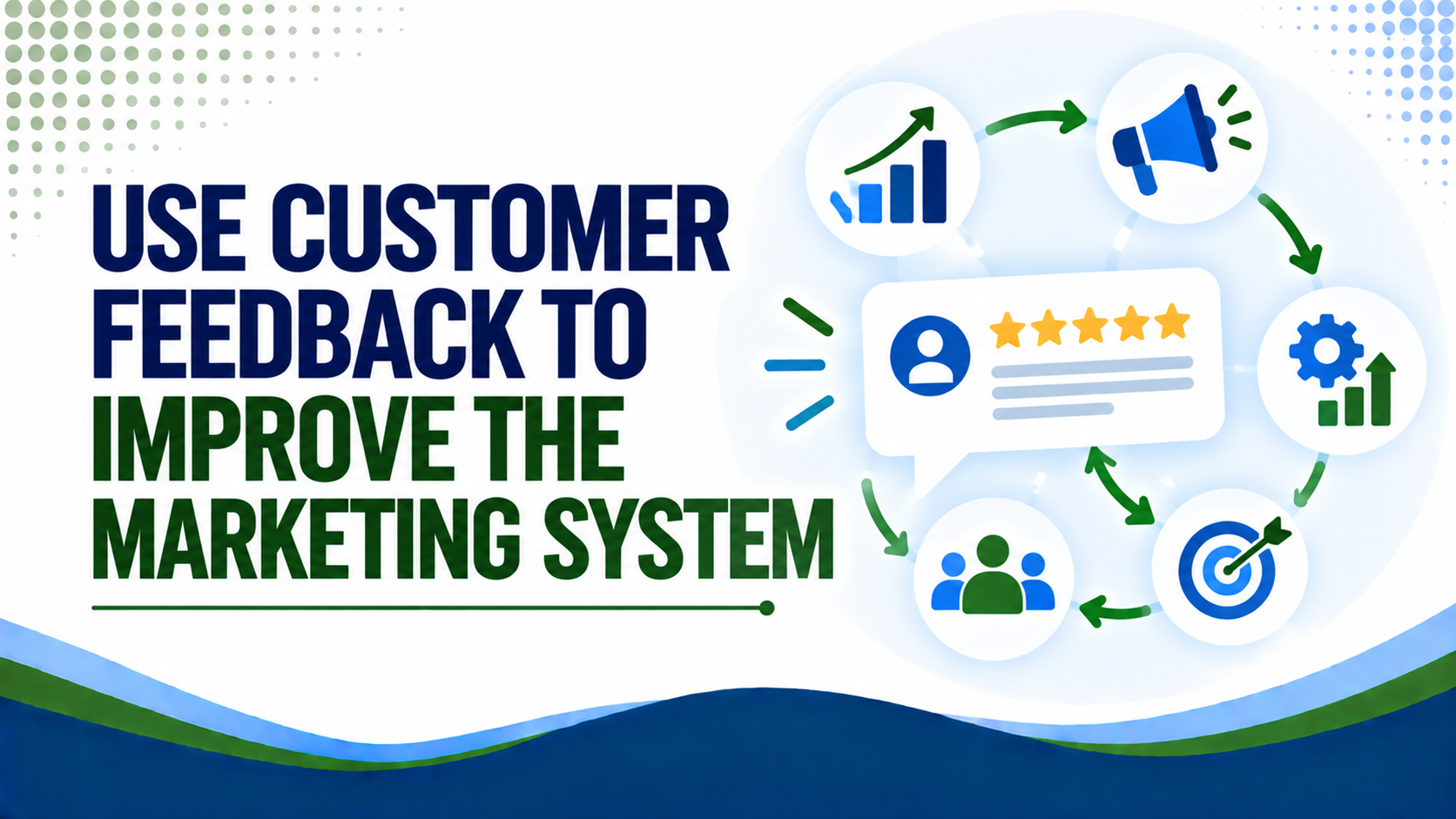
Review marketing should eventually become a feedback loop:
Customer Experience → Review → Insight → Content → New Customer → New Feedback
Over time, this creates an evolving library of voice-of-customer information.
Marketers can compare what customers say with what the company says about itself.
If the website emphasizes affordability while reviews consistently emphasize reliability, that deserves attention.
If advertising promotes speed while customers repeatedly praise detailed communication, that deserves attention too.
If reviews continually expose the same confusion before purchase, the website may need to answer that concern more clearly.
Customer feedback can therefore improve far more than testimonial content. It can help refine the company's overall messaging and positioning.
Avoid Turning Review Marketing Into Review Manipulation
There is an important difference between learning from reviews and trying to manufacture the feedback a marketing team wants.
Businesses should not script reviews to generate specific keywords, services, locations, or selling points.
A company that wants customers to praise communication should improve communication.
A business that wants reviews mentioning fast response should build a faster response process.
A contractor that wants customers to praise cleanliness should make cleanliness part of its operating standards.
Marketing should follow the customer experience, not attempt to manufacture it.
The stronger approach is simple:
Create experiences worth describing, make it easy for eligible customers to provide genuine feedback, and learn from what they voluntarily say.
Connect Review Marketing Across the Customer Journey
Reviews are often considered bottom-of-funnel content because customers read them while deciding which company to choose.
Their insights can support the entire customer journey.
At the awareness stage, customer problems can inspire educational content.
During consideration, reviews can reveal questions and objections that should be addressed.
During evaluation, testimonials and stories can provide relevant proof.
After conversion, customer feedback can identify ways to improve the experience.
That integration matters because prospective customers rarely experience marketing channels in isolation.
Someone might discover a business through search, visit its website, check reviews, encounter a social post, return through an advertisement, and finally call.
The messages they encounter should reinforce one another.
Customer feedback helps make that possible because every channel can draw insight from the same source: the experiences of people who have already done business with the company.
Stop Letting Your Best Customer Stories Sit on a Review Page

A strong customer review should help the next person evaluating your business, but its value does not have to end there.
Reviews can reveal the problems customers want solved, the questions they need answered, the language they naturally use, the benefits they value, the objections that delay decisions, and the experiences they remember enough to share.
A thoughtful review marketing strategy turns those insights into better marketing.
Some reviews can strengthen SEO content. Others can inspire social media stories, advertising concepts, testimonials, videos, FAQs, case studies, or stronger website messaging.
The goal is not to plaster five-star quotes across every channel. It is to listen carefully to what customers are already telling you and use those insights to create marketing that is more relevant, credible, and connected to real customer experiences.
When that process becomes consistent, reviews stop being something a business merely collects. They become a renewable source of customer intelligence and content ideas that can strengthen marketing across search, social media, advertising, and the broader customer journey.