
How to Build a First-Party Data Strategy for Your Local Business in 2026
Learn how to build a first-party data strategy for your local business by collecting, organizing, connecting, activating, and measuring customer information to improve marketing, retention, and growth.
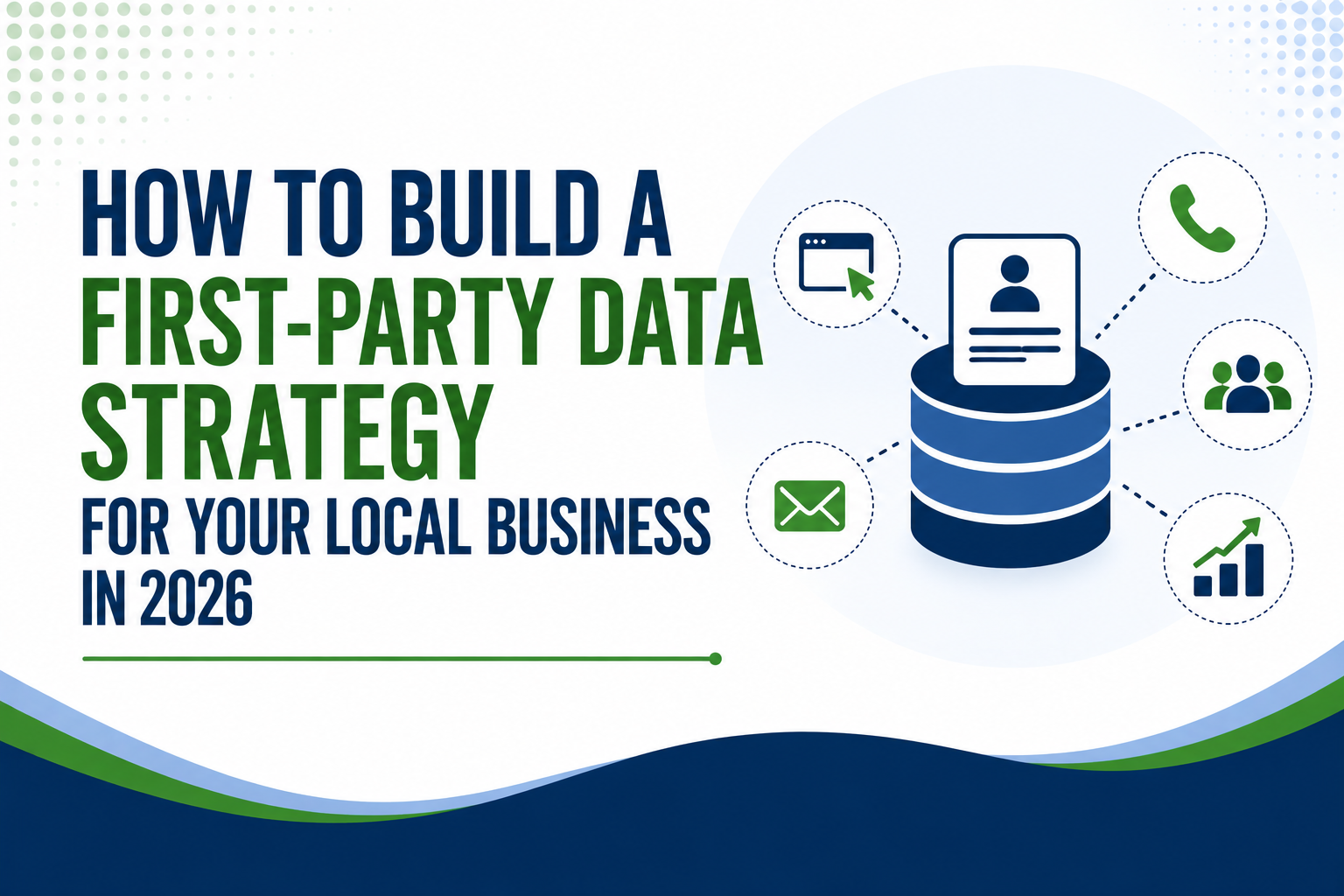

Local businesses collect valuable customer information every day.
A homeowner requests an estimate. A customer books an appointment. Someone calls after finding the company on Google. Another person fills out a website form, joins an email list, makes a purchase, or returns six months later for another service.
Each interaction can create first-party data.
The problem is that many businesses never turn that information into a coordinated marketing asset. Customer details may be scattered across a CRM, email platform, website forms, scheduling software, spreadsheets, point-of-sale systems, and employees' inboxes.
In 2026, that fragmentation matters more than ever.
Digital marketing is becoming more dependent on reliable customer information, stronger measurement, responsible data practices, and direct relationships between businesses and their audiences. A well-designed first-party data strategy can help local businesses understand customers more clearly, improve marketing decisions, build stronger audiences, and measure what actually generates revenue.
The goal is not to collect as much information as possible.
It is to collect the right data, with the right permissions, organize it effectively, and put it to useful work.
What Is First-Party Data?
First-party data is information a business collects directly through its own interactions with customers, prospects, and audiences.
Unlike information purchased or obtained indirectly from an outside source, first-party data originates from a relationship the business has with the individual.
For a local business, examples can include:
- Contact information submitted through a website form
- Email newsletter subscriptions
- Phone inquiries
- Appointment and booking information
- Purchase and transaction history
- CRM records
- Customer service interactions
- Website behavior collected through properly configured analytics
- Customer preferences
- Survey responses
- Loyalty program activity
- Email engagement
- Quote and estimate requests
- Repeat purchase or service history
The distinction matters because these interactions can provide information about people who have already demonstrated some level of interest in the business.
Someone who requests an HVAC replacement estimate, for example, has provided a much stronger signal of commercial intent than an anonymous person who happens to fit a broad demographic profile.
A first-party data strategy creates a system for capturing and using those direct signals responsibly.
Why First-Party Data Matters More for Local Businesses in 2026
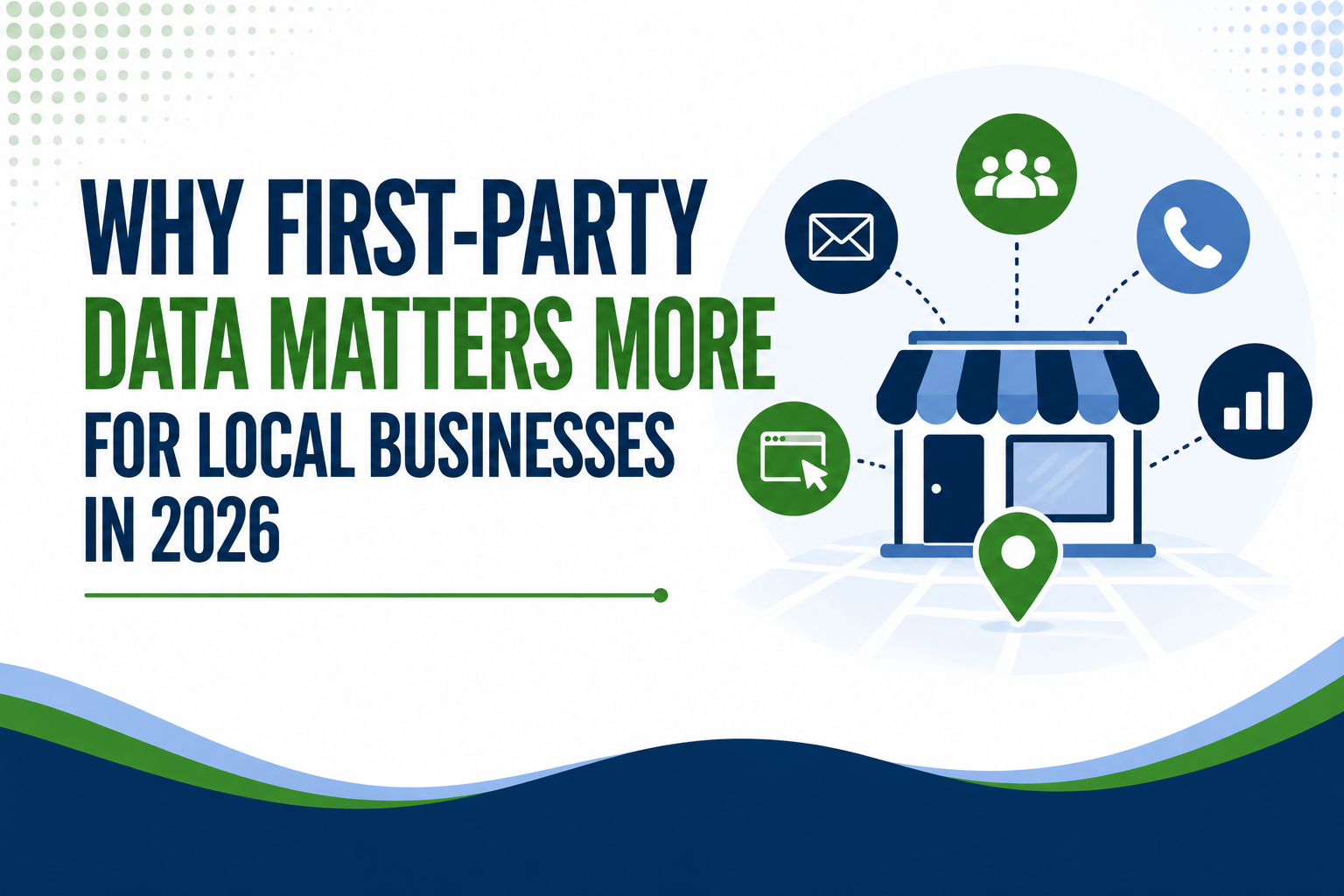
Local businesses frequently operate with smaller marketing budgets than national brands. That makes wasted advertising, poor targeting, disconnected customer records, and weak attribution particularly costly.
First-party data can help reduce some of that uncertainty.
Instead of treating every prospect as an unknown visitor, businesses can use information from previous interactions to better understand which services generate leads, which customers return, which marketing sources produce valuable relationships, and where opportunities exist for retention.
This also connects directly to building a more predictable local lead generation system. Lead generation becomes more useful when a business can identify what happens after the lead arrives rather than measuring success solely by form submissions or phone calls.
You Gain a Better Understanding of Your Actual Customers
Advertising platforms can provide audience insights and targeting tools, but no outside platform understands your customer relationships as directly as your own business can.
Your records may reveal:
- Which services customers purchase most frequently
- Which services tend to lead to repeat business
- Which locations generate higher-value customers
- How long customers typically wait before purchasing again
- Which leads become customers
- Which marketing sources produce qualified opportunities
- Which customers generate the greatest lifetime value
Those insights can influence far more than advertising.
They can inform service priorities, email campaigns, website content, seasonal promotions, retention efforts, and budgeting.
Better Data Can Improve Marketing Measurement
One of the hardest questions in marketing is also one of the simplest:
Which marketing actually produced the customer?
The answer is often complicated.
A person may discover a company through local search, visit the website, leave, see an advertisement later, follow the company on social media, receive an email, and finally call.
If those interactions live in separate systems, the business may struggle to connect them.
This is why a first-party data strategy should complement broader search engine marketing and paid media reporting. Better customer information can help businesses move beyond counting clicks and begin evaluating qualified leads, customers, and revenue.
First-Party Data Your Local Business Probably Already Has
One misconception about first-party data is that implementing a strategy requires a sophisticated enterprise technology stack.
For many local businesses, the first step is much simpler.
Look at what you already have.
A contractor may have years of estimates and completed jobs in a CRM. A dental office may have appointment records. A fitness business may have membership and attendance information. A retailer may have transaction histories. A landscaping company may know which customers purchase recurring maintenance and which purchase large installation projects.
The challenge is often not a lack of data.
It is that useful information is distributed across systems that were never designed to work together.
Step 1: Decide What You Want Your Data to Accomplish
Before adding tracking tools, creating new forms, or moving customer information into another platform, define the business questions your data needs to answer.
A local service company might want to know:
- Which marketing channels produce the most qualified leads?
- Which services create the highest-value customers?
- Which customers are likely to need another service?
- How much does it cost to acquire a new customer?
- Which campaigns produce repeat business?
- Which prospects requested estimates but never booked?
- Which customer groups respond best to particular offers?
These questions determine what information is actually useful.
For example, if the goal is to improve profitability, simply knowing how many leads came from Google Ads is not enough. The business may need to connect advertising source, lead status, sale value, and repeat business.
That creates a much clearer picture of acquisition economics. Weslo's breakdown of customer acquisition cost versus lifetime value provides a useful framework for understanding why those downstream customer outcomes matter.
The important principle is simple:
Do not collect data first and decide what to do with it later.
Start with the decisions you want to improve. Then identify the information required to make those decisions.
Step 2: Collect First-Party Data at Meaningful Customer Touchpoints
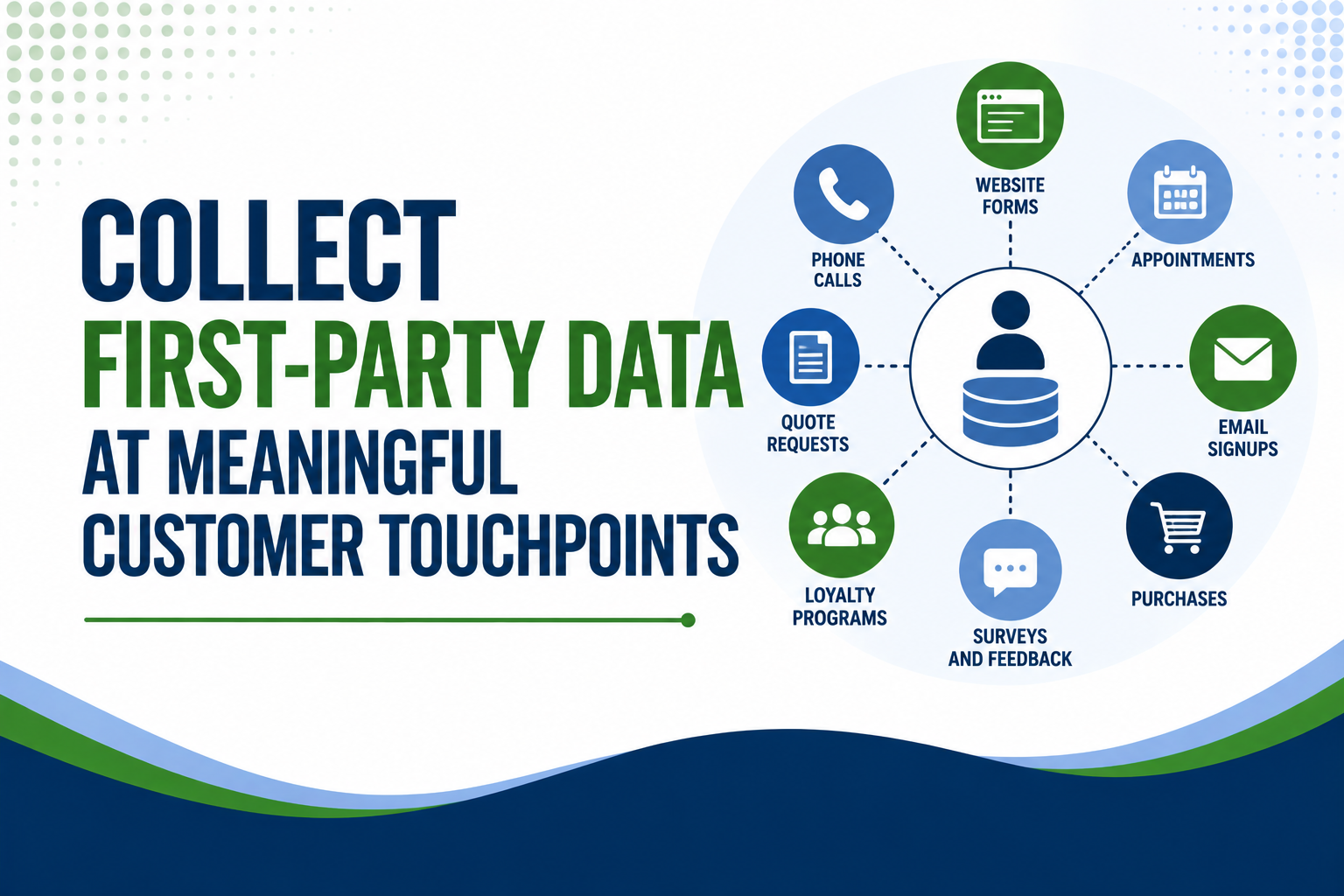
Once you know what you want your data to accomplish, identify the interactions where useful information can be collected.
For most local businesses, these opportunities already exist throughout the customer journey.
Someone may:
- Submit a contact form
- Request an estimate
- Call the business
- Schedule an appointment
- Subscribe to email
- Make a purchase
- Respond to a survey
- Join a loyalty program
- Leave a review
- Return for another service
The objective is not to turn every interaction into an opportunity to request more information. Collect only what has a clear business purpose.
A quote request might reasonably require a name, contact information, service needed, and location. Asking for unrelated information simply because it might be useful someday creates unnecessary friction and increases the amount of customer data the business must manage.
This is particularly important for website forms.
A form should collect enough information to help the business respond effectively without making the customer complete an interrogation before speaking with someone.
If a website attracts visitors but those visitors consistently fail to become inquiries, the problem may extend beyond traffic. Weslo's guide to why a website gets traffic but no leads explains why the experience after acquisition matters just as much as generating the visit.
Give Customers a Reason to Share Their Information
First-party data works best when there is a clear value exchange.
A customer may provide information because they want:
- An estimate
- An appointment
- A useful resource
- Service reminders
- Relevant promotions
- Product updates
- Loyalty benefits
- Faster future service
- Personalized recommendations
The customer should understand what they receive in exchange and, where appropriate, how the business intends to communicate with them.
That creates a healthier foundation than collecting information without a clear purpose.
Step 3: Organize the Data You Already Have
Collecting information is only useful if your team can find and understand it.
Imagine a local business where website leads go into an email inbox, phone inquiries are written in notes, completed jobs live in field-service software, newsletter subscribers are stored in an email platform, and advertising leads are visible only inside the advertising account.
Technically, the business has first-party data.
Operationally, it has fragments.
A practical first-party data strategy should create consistency around important fields such as:
- Customer name
- Contact information
- Lead source
- Service or product of interest
- Geographic location
- Lead status
- Customer status
- Appointment or purchase history
- Revenue or transaction value
- Communication permissions
Standardization matters.
If one employee records a lead source as "Google," another uses "Google Ads," and another writes "PPC," reporting can quickly become unreliable.
Businesses do not necessarily need an expensive enterprise data platform. They need a dependable source of truth and consistent rules for how important information is entered and maintained.
Clean Data Before You Build More Systems Around It
More technology does not fix poor-quality information.
Before connecting systems, review existing records for problems such as:
- Duplicate customers
- Invalid email addresses
- Inconsistent phone formats
- Missing lead sources
- Outdated records
- Incorrect customer statuses
- Duplicate CRM fields
- Unclear consent records
Clean data makes segmentation and reporting more dependable.
It also prevents businesses from spending money activating audiences built from inaccurate information.
Step 4: Connect Customer Data Across the Marketing Journey
Once information is organized, the next goal is to connect important customer interactions wherever practical.
This does not mean every piece of software needs to contain every available data point.
Instead, focus on the connections needed to answer important business questions.
For example:
Ad click → Website visit → Form submission → Qualified lead → Customer → Revenue
Without those connections, a marketing platform may report a successful form submission while the sales team knows the lead was irrelevant.
With stronger first-party data connections, the business can begin distinguishing between campaigns that produce activity and campaigns that produce customers.
That distinction is particularly important for paid advertising, where optimizing toward better customer outcomes can be more valuable than simply generating the highest possible number of inexpensive leads.
Create a Useful Customer View
A practical customer record might include:
Step 5: Make Privacy and Consent Part of the Strategy
Customer trust should be built into a first-party data strategy from the beginning.
Businesses should be transparent about the information they collect, why they collect it, and how it will be used.
That includes maintaining an appropriate privacy policy, establishing consent processes where required, protecting customer information, controlling access, and retaining data only as appropriate for legitimate business purposes.
Privacy requirements can vary by jurisdiction, industry, type of information, and intended use, so businesses should obtain appropriate legal or compliance guidance for their circumstances.
The practical marketing principle is straightforward:
Collect what you need, explain why you need it, protect it, and use it consistently with the permissions provided.
A first-party relationship becomes less valuable, not more valuable, if the way a business uses customer information damages trust.
Step 6: Activate First-Party Data Across Your Marketing
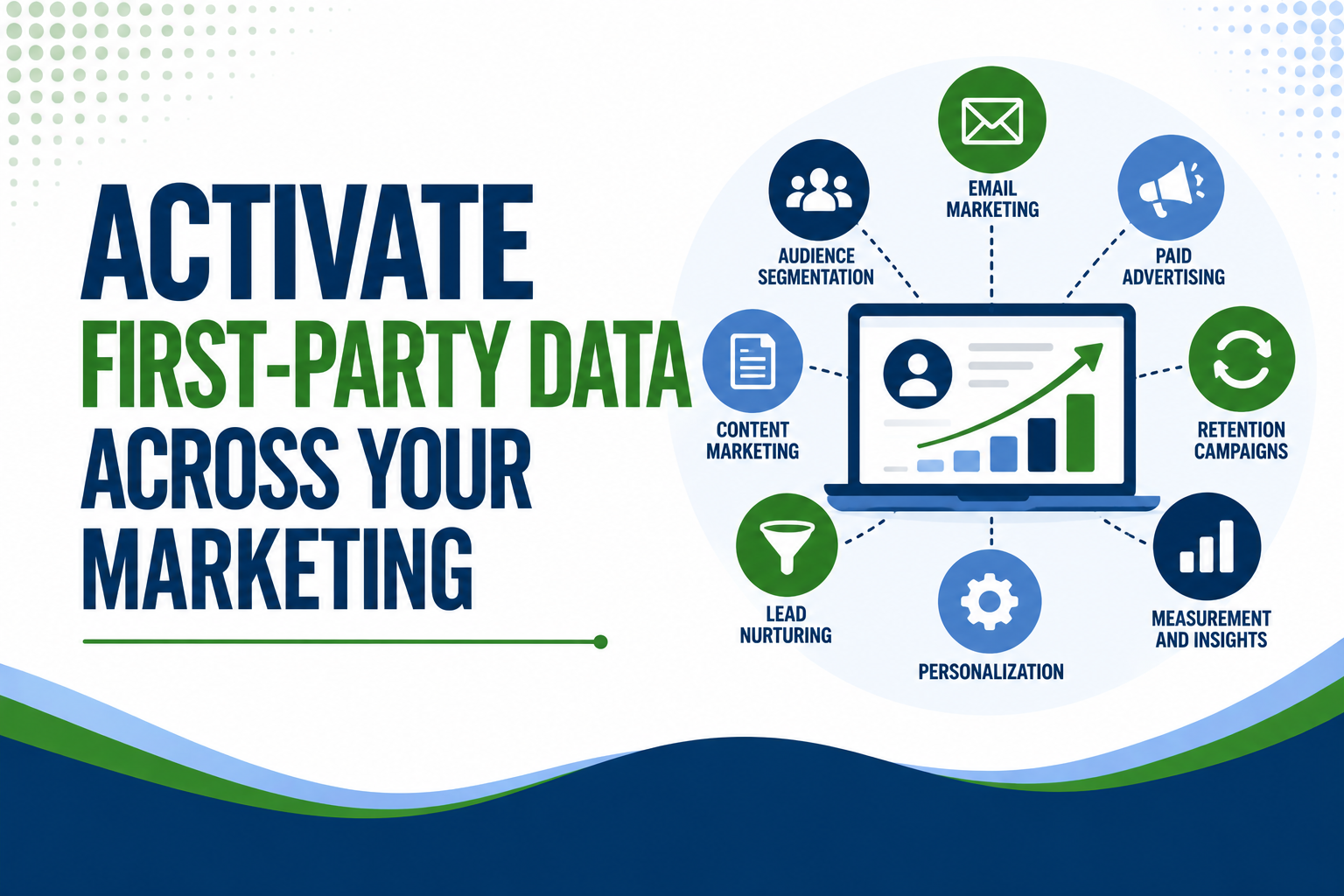
Once customer information is collected, organized, and connected responsibly, it can begin improving marketing decisions.
Activation means using the information for a legitimate business or marketing purpose rather than allowing it to sit unused in a CRM.
Build More Relevant Customer Segments
Not every customer should receive the same message.
A home service company might distinguish between:
- New leads who have not booked
- Recent customers
- Long-term customers
- Customers due for recurring service
- High-value customers
- Customers interested in specific services
- Previous customers who have become inactive
A fitness company might segment members based on membership status or engagement. A retailer might distinguish first-time buyers from repeat customers.
Segmentation allows marketing to become more relevant without requiring one-to-one personalization for every individual.
Improve Lead Nurturing
Many prospects do not purchase during their first interaction.
Someone may request an estimate and postpone the project. Another person may download information while researching options. A customer may inquire about one service but become a better candidate for another later.
With appropriate permissions and systems, businesses can build follow-up processes around those customer stages.
This can make existing leads more valuable instead of forcing the business to continually replace every unconverted prospect with another paid lead.
Strengthen Advertising Audiences and Measurement
First-party customer information can also support advertising strategies when used in accordance with applicable platform policies and privacy requirements.
Businesses may be able to use eligible customer information to create audience lists, improve exclusions, support remarketing, or provide platforms with stronger conversion signals.
The important shift is from optimizing marketing around cheap activity toward meaningful outcomes.
A campaign generating a $25 lead is not necessarily more successful than one generating a $60 lead if the second campaign consistently produces higher-value customers.
Understanding what a good cost per lead means for a local business requires looking beyond the initial lead price and considering lead quality and customer economics.
Step 7: Use First-Party Data to Improve Customer Retention
First-party data is not only an acquisition tool.
Some of its greatest value can appear after the first purchase.
A business with accurate service or purchase history can identify opportunities for:
- Maintenance reminders
- Rebooking campaigns
- Replenishment reminders
- Warranty communication
- Relevant complementary services
- Loyalty offers
- Customer feedback requests
- Review campaigns
- Win-back campaigns
This is particularly valuable for businesses where customers may need another service months or years later.
Without an organized customer database, the company may effectively start its marketing relationship from zero every time.
With one, the business can remain useful and relevant throughout the customer lifecycle.
Step 8: Measure Whether Your First-Party Data Strategy Is Working
A successful first-party data strategy should produce measurable improvements, not simply a larger database.
The right metrics depend on the original goals established in Step 1.
Useful measurements can include:
Data Quality Metrics
- Percentage of leads with a known source
- Duplicate record rate
- Percentage of records with complete key fields
- Percentage of customers with documented communication preferences
Marketing Metrics
- Conversion rate by source
- Cost per qualified lead
- Lead-to-customer rate
- Email engagement by segment
- Re-engagement rate
- Campaign conversion rate
Business Metrics
- Customer acquisition cost
- Repeat purchase rate
- Retention rate
- Average customer value
- Customer lifetime value
- Revenue by acquisition source
- Revenue from returning customers
These measurements help determine whether better customer information is actually producing better decisions.
For example, a business may discover that one advertising channel generates twice as many leads as another but substantially fewer customers.
Without first-party sales data, the first channel may appear superior.
Once lead and customer information are connected, the business can make a more informed budget decision.
The First-Party Data Strategy Framework
Local businesses do not need to transform their entire technology stack overnight.
A first-party data strategy can develop through five practical stages:
Common First-Party Data Mistakes Local Businesses Should Avoid
A good strategy is as much about what a business avoids as what it implements.
Collecting Data Without a Clear Purpose
More fields do not automatically create more insight. Every important data point should connect to a legitimate operational, customer, or marketing purpose.
Keeping Information in Disconnected Systems
Data that cannot be connected to meaningful customer outcomes limits the business's ability to evaluate marketing performance.
Failing to Maintain Data Quality
Outdated, duplicated, or inconsistently categorized records can undermine reporting and segmentation.
Treating Every Customer the Same
A new prospect, repeat customer, inactive customer, and high-value customer have different relationships with the business. Marketing should reflect those differences where appropriate.
Ignoring Privacy and Permissions
Customer information should never be treated as something a business can use without limits simply because it collected the data directly.
Measuring Leads Instead of Customers
Lead volume can hide poor lead quality. Connecting marketing data to actual customers helps reveal which strategies are contributing to growth.
Start Building a Customer Data Asset Your Business Controls
A strong first-party data strategy does not begin with buying more software.
It begins with understanding what your business wants to know about its customers and what information is legitimately needed to answer those questions.
From there, the process becomes manageable:
Collect useful information. Organize it consistently. Connect important interactions. Activate it responsibly. Measure the results.
For local businesses, the opportunity is significant because much of the required information may already exist.
Website inquiries, calls, estimates, appointments, purchases, customer records, and repeat service history can become more valuable when they are treated as parts of the same customer relationship rather than isolated transactions.
That stronger foundation can improve advertising, retention, attribution, customer experience, and marketing decisions.
Most importantly, it gives your business a clearer understanding of the people behind the clicks, calls, and leads.
In 2026, that understanding can be one of the most valuable marketing assets a local business builds.

