The New SEO Scorecard: SEO Metrics to Measure Beyond Rankings and Traffic
Rankings and website traffic no longer tell the whole SEO story. Learn which SEO metrics businesses should track to measure search visibility, AI presence, engagement, qualified leads, conversions, revenue, and real business growth.



For years, SEO reporting revolved around a familiar set of numbers: keyword rankings, organic traffic, impressions, clicks, and perhaps a few conversion metrics.
Those numbers still matter. But they no longer tell the full story of how people discover, evaluate, and choose businesses online.
Search has expanded beyond the traditional list of blue links. AI-generated answers can influence decisions before a user ever reaches a website. Google Business Profiles can generate calls and directions without a website visit. Brand mentions can increase familiarity across search, social media, and AI platforms. A customer may encounter a business several times before finally converting through a channel that receives all the credit.
That means businesses need a broader way to evaluate SEO performance.
The modern SEO scorecard should measure not only whether a website ranks, but also whether a brand is visible, discoverable, trusted, cited, and generating meaningful business results.
Why Traditional SEO Reporting No Longer Tells the Whole Story
Rankings became one of SEO's dominant measurements for an obvious reason. If someone searches for a service and your business appears near the top of Google, you have a greater opportunity to earn attention.
Traffic provides another useful signal. Growing organic sessions can indicate that a website is becoming more discoverable.
The problem begins when either number is treated as the final measure of success.
A number-one ranking that generates no qualified inquiries has limited business value. A 40 percent increase in organic traffic is far less impressive if most visitors leave without taking meaningful action.
Conversely, a business could strengthen its search presence even when website traffic does not increase proportionally.
Consider a local customer searching for a service. They might:
- See the company in a local result.
- Read information directly within Google.
- Encounter the company again in an AI-generated response.
- Notice the brand on social media.
- Search for the company by name several days later.
- Call directly from its Google Business Profile.
A traditional website analytics report may capture only part of that journey.
This is one reason modern search engine marketing needs to connect search visibility with user behavior and business outcomes rather than evaluating isolated numbers.
The question is no longer simply, "Where do we rank?"
It is also:
How visible are we?
Are the right people finding us?
Does that visibility create demand?
Do visitors take meaningful actions?
Does search contribute to leads and revenue?
Those questions require a broader set of SEO metrics.
Start With Traditional SEO Metrics, But Put Them in Context
Expanding an SEO scorecard does not mean abandoning conventional measurements. Rankings, impressions, clicks, click-through rate, and organic traffic remain important diagnostic indicators.
They simply need context.
Keyword Rankings
Rankings help determine whether pages are becoming more competitive for relevant searches.
But average ranking alone can hide important details.
A business might improve from position 60 to position 18 for dozens of irrelevant keywords while losing top-three visibility for its highest-value service. An SEO report showing only "number of ranking keywords" could make that situation look positive.
Instead, rankings should be segmented according to factors such as:
- Commercial versus informational intent
- Branded versus non-branded searches
- Priority services or products
- Geographic markets
- High-value keywords
- Search features and local results
This turns rankings from a vanity number into a useful diagnostic metric.
Search Impressions
Impressions indicate how often pages from your site are shown in eligible Google search results.
Increasing impressions can be an early sign that Google is associating your website with a broader range of relevant searches, even before those impressions translate into significant traffic.
Impressions are particularly useful when evaluated alongside rankings, queries, pages, and clicks.
Organic Clicks and Click-Through Rate
Clicks tell you whether search visibility is generating website visits, while click-through rate can help reveal how effectively a search result earns attention.
A page can rank well and still produce a disappointing click-through rate.
That could indicate a mismatch between the searcher's intent and the page, or it may point toward opportunities to improve titles, descriptions, positioning, and the way the brand appears in search.
Organic Website Traffic
Organic traffic remains an important SEO metric because it measures actual visits generated through unpaid search.
But traffic should always be interpreted alongside quality and outcomes.
Ten thousand monthly organic visits from users who have little likelihood of becoming customers can be less valuable than 1,000 highly relevant visits from people actively researching the company's services.
This distinction becomes particularly important when evaluating content. A broad informational article can attract significant traffic without producing the same commercial value as a service page that attracts fewer visitors but consistently generates qualified leads.
That is why the new SEO scorecard needs to move beyond volume and begin measuring visibility, quality, and impact.
Search Visibility: Measure More Than Individual Rankings

One of the most useful additions to an SEO scorecard is overall search visibility.
Individual rankings answer a narrow question:
Where does this page rank for this keyword?
Search visibility asks something larger:
How visible is our brand across the searches that matter to our customers?
A company may rank number one for several keywords and still have relatively weak visibility across its overall market. Another may occupy top-five positions across hundreds of relevant searches and therefore command substantially more attention.
Visibility can be evaluated across:
- Priority commercial keywords
- Informational searches
- Local search results
- Google Maps
- Featured results
- Branded queries
- Relevant non-branded queries
- AI-assisted search experiences
This provides a better understanding of how much of the customer's search journey a brand actually occupies.
For local businesses, this measurement becomes even more important. A customer looking for a contractor, restaurant, medical provider, or professional service may interact with a local result without visiting the company's website first.
Share of Voice
Share of voice takes the visibility concept a step further by comparing your search presence with competitors.
Instead of asking whether rankings improved, it asks:
How much of the available search visibility does our business own compared with other brands competing for the same audience?
A simplified example might look like this:
This type of comparison makes SEO performance easier to interpret.
Moving a keyword from position eight to position four is useful. Increasing your overall share of relevant search visibility while competitors lose ground tells a much more meaningful competitive story.
Branded Search: Are More People Looking for You by Name?
One SEO metric that businesses frequently overlook is branded search demand.
Branded searches include queries containing your company name, product names, key people, or other terms closely associated with your brand.
Why does this matter?
Because SEO does not always generate an immediate click or conversion. Someone might discover your business through an informational article, see your company in Google Maps, encounter a social post, or notice your brand referenced elsewhere. Instead of converting immediately, that person may remember the business and search for it later.
An increase in branded searches can therefore indicate something bigger than keyword performance. It can suggest that your overall digital presence is creating awareness and demand.
Useful branded search signals include:
- Searches for your business name
- Business name plus service
- Business name plus location
- Searches for branded products or solutions
- Searches for key people associated with the company
- Changes in branded impressions and clicks over time
Branded search should not be attributed exclusively to SEO because advertising, referrals, offline marketing, social media, and word of mouth can all contribute to it.
However, tracking its direction over time gives businesses another way to understand whether their digital visibility is translating into recognition.
That becomes increasingly valuable as search and social media marketing overlap. A customer may discover a brand on one platform and intentionally search for it on another.
AI Search Visibility: Is Your Brand Appearing in AI-Generated Answers?

The emergence of AI-assisted search introduces another layer to SEO measurement.
Traditional search reporting focuses heavily on a website's position in search results. AI-generated experiences work differently. A platform may synthesize information from multiple sources and mention, cite, or recommend a business without producing the same type of conventional ranking.
That means companies increasingly need to ask:
Does our brand appear when AI systems answer questions relevant to our market?
This is especially important for businesses publishing authoritative educational content.
For example, imagine a company has spent years producing useful resources about a specialized service. A prospective customer asks an AI search tool a detailed question about that service. The system may reference the company's information or mention its brand as part of the answer.
That exposure has value even if it does not immediately create a website session.
This does not mean businesses should abandon conventional SEO and chase an entirely separate "AI SEO" strategy. Many of the foundations remain connected. Useful content, clear site architecture, authority, relevance, strong brand signals, and accessible information continue to matter.
Read about out how AI search is changing SEO for local businesses to understand this shift in greater detail.
AI Mentions and Citations
Two emerging SEO metrics worth monitoring are AI mentions and AI citations.
An AI mention occurs when a brand, product, expert, or business appears within an AI-generated answer.
An AI citation occurs when the answer specifically references or links to content associated with that brand.
These signals are not identical to rankings.
A company might rank strongly in conventional Google results but appear infrequently in AI answers. Another business might earn frequent citations because its website contains highly useful explanations, original research, statistics, or resources that systems repeatedly reference.
Businesses can begin tracking:
- Frequency of brand mentions in relevant AI responses
- Pages receiving AI citations
- Topics for which the brand appears
- Competitors appearing in the same responses
- AI referral traffic where identifiable
- Changes in visibility across strategically important questions
These measurements are still evolving, so they should not be treated with the same precision as a closed-loop conversion report.
Their value is directional.
If customers are increasingly discovering information through AI-generated experiences, brands need some understanding of whether they are present in those experiences.
Engagement Metrics: What Happens After Someone Finds You?
Visibility gets a business into consideration. The next question is whether the resulting experience actually helps the user.
This is where engagement metrics become useful.
Businesses should avoid reducing engagement to one universal benchmark. The right behavior depends heavily on the purpose of the page.
Someone visiting a short contact page may convert within seconds. Someone reading a 2,500-word educational article may spend several minutes researching before leaving and returning another day.
Useful engagement indicators can include:
- Engaged sessions
- Engagement rate
- Time spent with important content
- Scroll depth
- Video engagement
- Internal navigation
- Visits to high-intent pages
- Repeat visits
- Downloads or other micro-conversions
These metrics help answer a critical question:
Did the searcher find enough value to continue interacting with the business?
A page generating thousands of visits but almost no meaningful engagement may be attracting the wrong audience or failing to satisfy the intent behind the query.
Likewise, a service page with relatively modest traffic but strong engagement and consistent inquiries may be one of the website's most valuable SEO assets.
This is also where website experience becomes inseparable from SEO performance. If search successfully brings the right visitors to a site but poor usability prevents them from converting, the SEO report should not stop at celebrating the traffic. Why websites get traffic but no leads demonstrates why acquisition and conversion need to be evaluated together.
Conversion Metrics: Does Organic Visibility Produce Action?
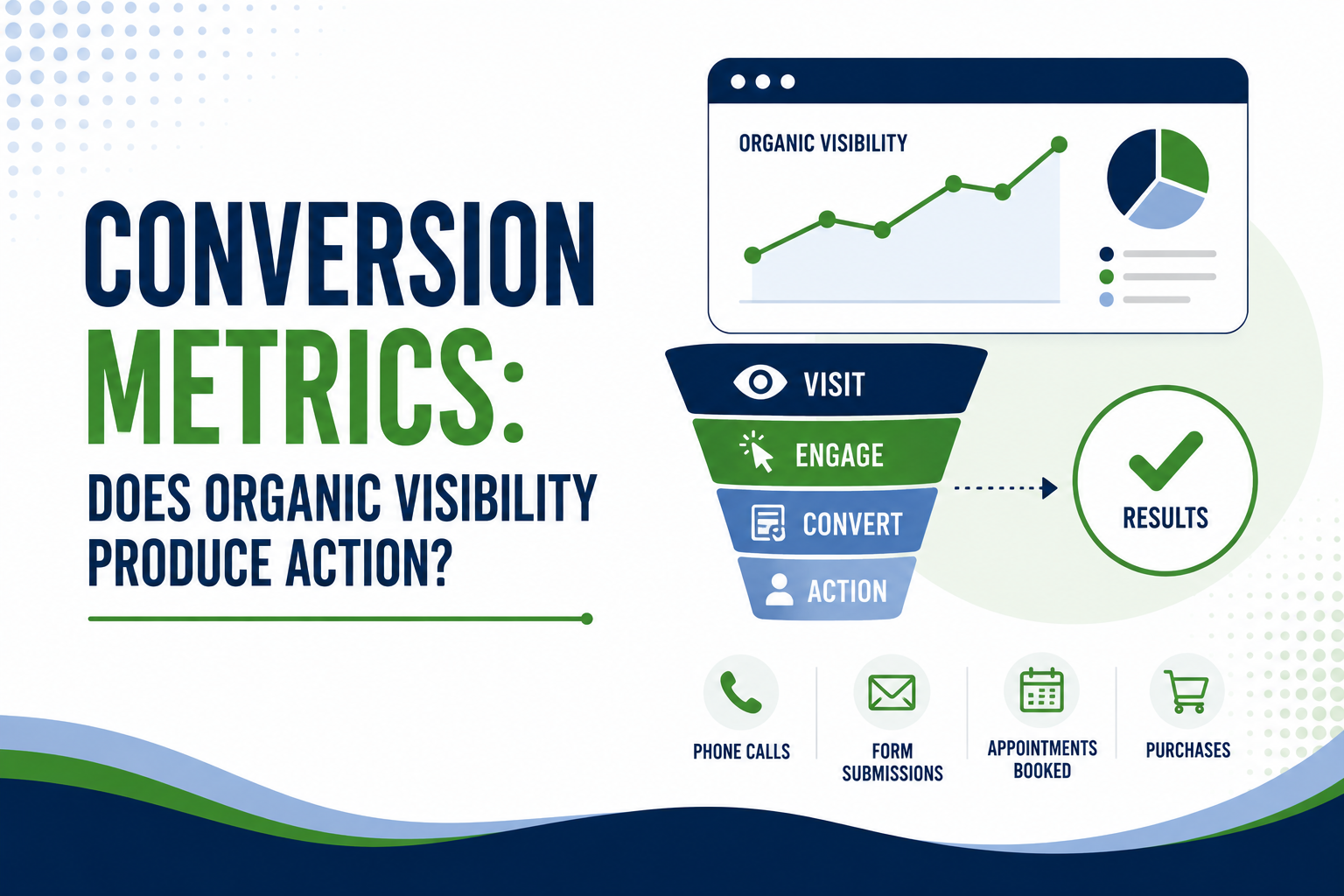
Traffic tells you that somebody arrived.
Conversions tell you whether they did something meaningful.
For most businesses, this is where SEO reporting should begin moving closer to actual commercial performance.
Primary conversions might include:
- Phone calls
- Contact form submissions
- Appointment bookings
- Purchases
- Quote requests
- Demo requests
- Consultation requests
Businesses can also track micro-conversions that indicate progression toward a larger goal, such as downloading a resource, watching an important video, subscribing to email, or visiting a pricing page.
The key is deciding which actions genuinely matter.
A report containing 500 "conversions" is meaningless if most of those conversions are minor events that have little connection to revenue.
Conversion Rate
Organic conversion rate provides additional context because it evaluates outcomes relative to traffic.
Imagine two months of SEO performance:
Looking only at traffic would suggest performance declined.
Looking at business outcomes tells the opposite story.
Traffic fell by 8 percent, but qualified leads increased by approximately 35 percent. The business attracted fewer organic visitors but converted considerably more of them.
That is precisely why rankings and traffic cannot function as the entire SEO scorecard.
Measure Lead Quality, Not Just Lead Volume
Even conversions can provide an incomplete picture.
Suppose SEO generates 100 form submissions this month compared with 70 last month. On the surface, that looks like significant growth.
But what if only 15 of the 100 new leads are qualified prospects?
Lead volume should therefore be paired with lead quality.
Depending on the business, useful measurements might include:
- Marketing-qualified leads
- Sales-qualified leads
- Booked appointments
- Estimates delivered
- Opportunities created
- Closed customers
- Average deal value
- Customer acquisition cost
This is where SEO begins moving from marketing reporting into business reporting.
The same principle applies when evaluating acquisition costs. Knowing what represents a good cost per lead for a local business becomes much more useful when lead cost is evaluated alongside quality and revenue potential.
A marketing channel that generates inexpensive but poorly qualified leads may ultimately be more expensive than a channel producing fewer high-quality opportunities.
Revenue and SEO ROI: Connect Search to Business Performance
Ultimately, businesses invest in SEO because they expect it to contribute to growth.
That makes revenue and return on investment important components of the new SEO scorecard.
Depending on the company's analytics and CRM infrastructure, teams may be able to measure:
- Revenue attributed to organic search
- Pipeline influenced by organic search
- Revenue per organic lead
- Customer acquisition cost
- Customer lifetime value
- Cost per qualified organic lead
- SEO investment versus attributable revenue
Perfect attribution is difficult because customer journeys are rarely linear.
A prospect might discover a company through Google, return through a branded search, watch videos, follow the business on social media, click an advertisement weeks later, and finally call.
Giving 100 percent of the credit to the final interaction would obscure the role SEO played in creating the relationship.
For that reason, businesses should look at both direct attribution and broader influence.
The objective is not to force every customer journey into one perfect number. It is to develop enough visibility to understand whether SEO is helping create profitable customer acquisition.
Local SEO Metrics Need Their Own Scorecard
Local businesses have an additional challenge because valuable search interactions often happen without a traditional website visit.
A customer can discover a company through Google, view its profile, read reviews, check operating hours, request directions, or make a call without first entering the website.
That means local SEO performance needs to include metrics beyond website analytics.
Important local SEO metrics can include:
- Google Business Profile views
- Calls originating from the profile
- Website visits from local listings
- Direction requests
- Local keyword visibility
- Google Maps visibility
- Review volume
- Review velocity
- Average review rating
- Local conversion actions
Businesses should also evaluate these signals over time rather than reacting to one month's movement in isolation.
A growing number of profile interactions combined with stronger local visibility and increasing calls may demonstrate meaningful progress even if website sessions remain relatively stable.
This is why maintaining and optimizing a Google Business Profile should be viewed as part of the wider search strategy rather than as a disconnected marketing task.
Build an SEO Scorecard Around Four Measurement Layers
With so many possible SEO metrics available, reporting can easily become overwhelming.
The answer is not to track everything.
It is to organize measurements according to the questions they answer.
A practical modern SEO scorecard can be divided into four layers.
The advantage of this structure is that each layer provides context for the next.
Rankings help explain visibility.
Visibility helps explain discovery.
Engagement helps explain whether that discovery is useful.
Conversions and revenue explain whether the entire process is contributing to growth.
Instead of presenting executives with dozens of disconnected numbers, an SEO report can tell a coherent story about how search contributes to the business.
How Often Should Businesses Review SEO Metrics?
Not every SEO metric needs to be evaluated at the same frequency.
Operational metrics such as indexing issues, sudden traffic changes, tracking errors, or major ranking losses may require frequent monitoring.
Strategic performance should generally be evaluated across longer periods.
SEO often develops gradually. Week-to-week fluctuations can distract teams from the larger direction of performance.
A useful reporting rhythm may include:
Weekly Monitoring
Watch for major technical problems, unusual traffic changes, tracking failures, and significant visibility losses.
Monthly Reporting
Review rankings, impressions, clicks, organic traffic, engagement, conversions, Google Business Profile activity, and lead performance.
Quarterly Strategic Review
Evaluate broader trends such as share of voice, branded demand, AI visibility, qualified leads, pipeline, revenue contribution, and competitive movement.
The goal is to separate monitoring from decision-making.
A metric can be monitored frequently without requiring a strategy change every time it moves.
What a Good SEO Report Should Tell You
A strong SEO report should make the state of search performance understandable even to someone who does not work in SEO every day.
After reviewing it, a business owner or marketing leader should be able to answer:
- Are we becoming more visible for searches that matter?
- Are we gaining or losing ground against competitors?
- Are more people actively searching for our brand?
- Are we appearing in emerging AI search experiences?
- Are organic visitors engaging with the website?
- Is SEO generating qualified leads?
- Are those leads becoming customers?
- Is SEO contributing to revenue and growth?
If a report contains 50 charts but cannot answer those questions, it is not providing enough strategic value.
Measure the SEO Outcomes That Actually Move the Business

Rankings and website traffic are not obsolete.
They remain valuable SEO metrics, and businesses should continue tracking them.
What has changed is the role those numbers play.
A ranking is an indicator of search visibility, not the final business outcome. Traffic measures visits, not customer value. Even a conversion does not tell the complete story if the resulting lead is unqualified.
The modern SEO scorecard connects the entire chain:
Visibility → Discovery → Engagement → Conversion → Qualified Opportunity → Revenue
It should also acknowledge that discovery now happens across more environments. Traditional search results, Google Maps, business profiles, AI-generated answers, websites, and other digital touchpoints can all influence how someone comes to recognize and trust a company.
Businesses that measure only rankings and traffic risk optimizing for numbers that look impressive while overlooking the outcomes that actually matter.
The better approach is to combine traditional SEO measurements with visibility, brand demand, AI presence, engagement, lead quality, and commercial performance.
That is how SEO reporting becomes more than a ranking report.
It becomes a measurement system for understanding how search contributes to business growth.